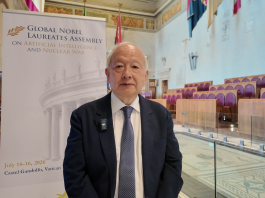

In the radiant tapestry of visionary leadership, where intellect intertwines with boundless creativity, emerges a portrait of a Rector, Ms.Elena Savchenko, whose indomitable spirit illuminates the halls of the International University of Kyrgyzstan. With a palette vibrant with the crimson of decisiveness, textured by the luminous openness of trust, this leader weaves a digital masterpiece—a glowing campus of collaboration and growth. From neural networks to nurturing minds, their journey harmonizes logic and imagination, painting a future where tradition dances with innovation, and every challenge blossoms into opportunity. This introduction unveils a legacy of elegance, where algorithms sing with the beauty of art, and respect for human potential reigns as the immutable core of a transformative vision.


London Post: If you were to create a digital self-portrait reflecting your leadership style as a rector, what would be its dominant color, texture, and most surprising element?
Elena Savchenko:My leadership style would be depicted as a vibrant red, symbolizing energy and decisiveness. The portrait would have a bright, open texture to convey trust and transparency. The unexpected element would be a glowing digital campus, representing the university as a dynamic, collaborative hub for growth.


LP: Having designed neural networks and now leading a university, if you envisioned the International University of Kyrgyzstan as a neural network, what would be its input layer, hidden layers, and desired output?
ES: The input layer would consist of students with their talents and ambitions. Hidden layers would include education, research, mentorship, and support systems. The desired output would be graduates who launch innovative projects, contribute to industry, and drive impactful societal initiatives.


LP: Where does the initial algorithm for a new piece of digital art begin: a mathematical concept, an emotional state, or a fragment of reality?
ES: Inspiration for digital art often stems from a blend of real-world observations and personal imagination, such as a person, pattern, or spatial detail. Digital tools then transform these sparks into a cohesive visual creation.
LP: Your work blends rigorous logic with creative freedom. Do you see this as reconciling opposing forces, or were they never truly separate?
ES: Logic and creativity are not opposites in my view. A well-crafted algorithm can be as elegant as a painting, and a creative image can be as structured as a formula. My approach fosters a space where logic amplifies imagination, and creativity infuses systems with meaning.

LP: The Kurmanjan Datka Medal recognizes your support for women’s initiatives. If you visualized the future of women in STEM in Central Asia as a work of art, what would its palette and composition be?
ES: The artwork would feature a vibrant palette of blues and purples for technology and discovery, green for growth, and yellow for the energy of ideas. At its core, confident women would work in a digital environment where tradition and innovation complement each other.
LP: Your art exhibition in London marked a milestone in your creative journey. What did it reveal about the global dialogue between technology and traditional art forms?
ES: The London exhibition was a deeply personal milestone, evoking both pride and awe. Audiences appreciated the technological innovation and emotional warmth in my work, affirming that digital art can resonate as profoundly as traditional forms.
LP: Is there an inherent aesthetic beauty in a well-designed algorithm, akin to a perfectly composed painting? Can elegance in code be considered a form of art?
ES: Absolutely. A well-designed algorithm embodies beauty through simplicity, clarity, and efficiency, much like a harmonious artistic composition. Elegant code is a form of creative expression, articulated through the language of logic.


LP: Your research focuses on adaptive systems. How do you apply the principle of adaptive learning to personal and artistic growth when facing challenges?
ES: I approach challenges like an adaptive system, adjusting strategies based on new circumstances. When encountering creative or professional obstacles, I experiment with different tools, perspectives, or pacing, turning difficulties into opportunities for growth.
LP: If you could encode one core value from your academic, educational, or artistic practice into an immutable layer of a neural network shaping the future, what would it be?
ES: The core value would be respect for individuals and nurturing their potential. This principle keeps the focus on people, not just metrics, fostering lifelong learners and innovators who contribute meaningfully to society.
LP: If your life’s work were compiled into a retrospective exhibition, what would it be called, and which single artifact would take center stage?
ES: The exhibition would be titled “Team of the Future,” reflecting the collective potential of those I’ve worked with. At its center would be a student project that evolved from a simple idea into a tangible achievement, symbolizing the impact of my efforts.