

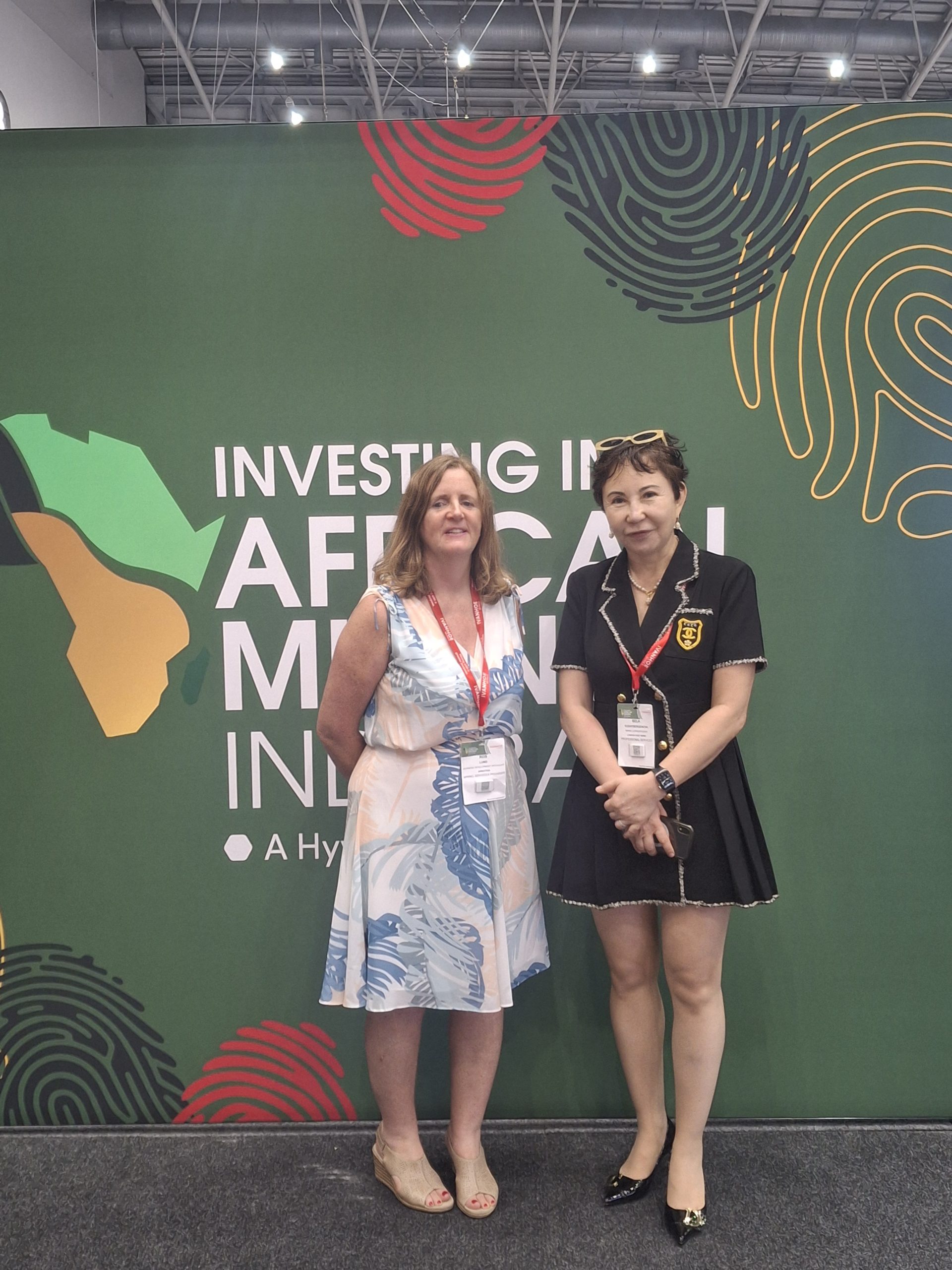
By Bela Kogan, Mining and Investment Correspondent, London Post
The market is growing. Britain is watching.
The global mining equipment market was valued at $148 billion in 2024 and is projected to reach $239 billion by 2033, growing at around 5.6% annually. The energy transition is the primary engine: lithium, copper, nickel and cobalt are needed for electric vehicles, batteries and renewable energy infrastructure at volumes that would have seemed implausible five years ago.
For British equipment manufacturers, this should be an obvious opportunity. The reality visible on the floor at Mining Indaba 2026 in Cape Town is more complicated. The UK has genuine industrial assets, a serious financial infrastructure, and an underused toolkit of government support — but deploys them inconsistently, and on the most important markets, China above all, is barely present.
A conversation with Ros Lund, business development specialist at Belfast-based Sensoteq, offers a useful entry point for understanding what is working, what is not, and what needs to change.
Northern Ireland: the quiet global hub
Start with what few people know. The industrial belt around Belfast manufactures over 40 percent of the world’s mobile crushing and screening equipment. This is not a marketing claim — it is a genuine share of a global market that most competitors would envy. The British mining equipment trade association ABMEC represents over 50 companies with combined supply volumes exceeding one billion dollars across domestic and export markets.
Sensoteq sits within this ecosystem, though with a different product. Founded roughly ten years ago by engineers from an automotive background, the company specialises in wireless sensors for condition monitoring in high-vibration environments — precisely the conditions where conventional monitoring systems either fail or become uneconomic.
Their technology addresses a deceptively difficult problem: how do you monitor equipment whose entire function is to vibrate? Vibrating screens sit at the centre of mineral processing, taking crushed ore and sorting it through high-frequency motion. When the vibration pattern drifts — an eccentric stroke, a loss of g-force, a structural crack altering the motion signature — the plant loses efficiency first, then capacity, then entire production shifts. “Before, people could monitor equipment that wasn’t supposed to vibrate,” Lund explains. “We monitor the ones that are.”
For a trader or investor this is not abstract. A mine with instrumented, predictable crushing and screening lines is more likely to honour shipment schedules, less likely to produce sudden force majeure surprises, and better placed to give lenders real operational data. Cutting corners on monitoring today means discounts, penalties and tighter credit terms tomorrow.
China: the largest market, the highest wall
The Chinese mining equipment market is valued at $33.78 billion in 2025. Chinese mining equipment exports grew at an annualised rate of 11.4% in the five years to 2024, driven by aggressive overseas expansion. Chinese manufacturers are no longer simply cheap alternatives: they are building technological sophistication, integrating their own condition-monitoring solutions tied to domestic digital platforms and 5G networks, and rapidly expanding their installed base across Belt and Road markets, including Africa.
This raises a fundamental question for British companies: compete with Chinese OEMs, or partner with them?
Sensoteq’s experience at Mining India 2026 is instructive. Meeting requests sent to Chinese manufacturers ahead of the event were declined. Informal approaches on the floor produced polite but non-committal conversations. “It feels difficult for us to engage with Chinese companies,” Lund acknowledges.
This is not a problem unique to Sensoteq — it is a structural barrier that British companies consistently encounter in China. Setting up a wholly foreign-owned enterprise in China can take six months or more, and intellectual property protection remains a serious risk: companies entering joint ventures with Chinese partners are required to share technology and commit to joint development in Chinese research centres.
Yet barriers are not the same as closed doors. Chinese policy is actively pushing the construction of green and intelligent mining demonstration projects, which is driving demand for high-quality monitoring and intelligent equipment management systems. After-sales service and maintenance are decisive factors in Chinese mining operators’ procurement decisions.
What actually works for entering the Chinese market, based on the experience of British companies that have done so successfully, points to several concrete approaches. Partnering with a Chinese distributor rather than attempting direct sales reduces the risk of causing loss of face in negotiations and gives immediate access to established relationships. Registering trademarks in China before opening negotiations — not after — protects against the widespread practice of bad-faith trademark registration. Attending Bauma China in Shanghai is significantly more productive for building relationships with Chinese OEMs than international forums such as Mining Indaba. Communicating via WeChat, which includes automatic translation, transforms the accessibility of conversations with manufacturers who do not operate through WhatsApp or email. And framing the product pitch around total cost of ownership rather than price alone: Chinese mining operators equipping autonomous mines with IoT sensors and predictive analytics are already willing to pay a price premium for integrated digital solutions.
Africa and beyond: where the British offer already lands
Africa’s mining equipment market is growing at 6.9% annually through 2030 — faster than the global average — driven by rapid expansion of copper, cobalt and lithium production in the DRC, Zambia and Tanzania.
This is where the British package — equipment, finance, law — works most convincingly. Sensoteq already works with Weir Minerals in the UK and several German OEMs, embedding sensors into equipment that is then sold globally, including across Africa. But the competitive advantage extends well beyond the product itself.
UK Export Finance offers loan guarantees for overseas projects — including mining, processing and manufacturing — where a long-term offtake contract is in place. In practice, this means a West or Central African buyer can finance a package of British equipment — crushers, screens, sensors and engineering services — at lower interest rates and over longer repayment periods than commercial banks would otherwise offer. The bank lends more cheaply because the government absorbs part of the risk.
London remains the global centre of mining finance, and UKEF has developed new financial instruments specifically tailored to the critical minerals sector. Under the Vision 2035 Critical Minerals Strategy, the UK government is committing up to £50 million to support critical minerals projects, supplementing existing UKEF and National Wealth Fund instruments.
For an investor sitting between the mine and the trading desk, this matters in concrete terms. A mine that finances its capital expenditure through UKEF, operates verified British equipment with independent condition monitoring, and structures its contracts under English law presents a fundamentally different counterparty risk profile than one that chose a cheaper but opaque alternative locked into a single Chinese hardware-and-data ecosystem.
What British manufacturers should do now
The data and the evidence from the field point to specific steps.
On China: stop waiting for Chinese companies to come to you. Get to Bauma China in Shanghai. Register your trademark early. Find a local distributor with genuine mining sector experience. Position your product through total cost of ownership and compatibility with Chinese digital platforms. Use WeChat as the primary channel for initial contact.
On Africa: use UKEF actively as a competitive tool, not merely as a backstop insurance mechanism. A buyer who understands the financing terms available through UKEF at the beginning of procurement discussions — not at the end — makes a different purchasing decision.
On positioning: data governed in a British jurisdiction, under English law, with independent analytics is not a technical footnote. It is a first-order commercial argument for mines raising Western project finance or trading on Western exchanges.
On institutions: ABMEC, trade attachés and the Department for Business and Trade have the resources to organise trade missions into China and to broker introductions to potential distributors. These channels are consistently underused.
The window is open, but not indefinitely
Competitive dynamics are intensifying: established OEMs are accelerating their shift to digital services, while fast-moving Chinese manufacturers are using cost advantage to capture share in price-sensitive segments. The technology landscape is bifurcating — one ecosystem of Western equipment with integrated analytics, another of Chinese equipment with domestic data layers. For mines operating mixed fleets, this already means fragmented data and a more complex risk picture.
British manufacturers — including those, like Sensoteq, only now stepping onto the international stage — have real assets: world-class technology, a financial infrastructure most competitors cannot match, and a reputation that still carries weight in the markets that matter.
The question is not whether the opportunity exists. The question is whether British manufacturers move quickly enough to take it.
The sensors are ready. The screens are shaking. The market is not waiting.


