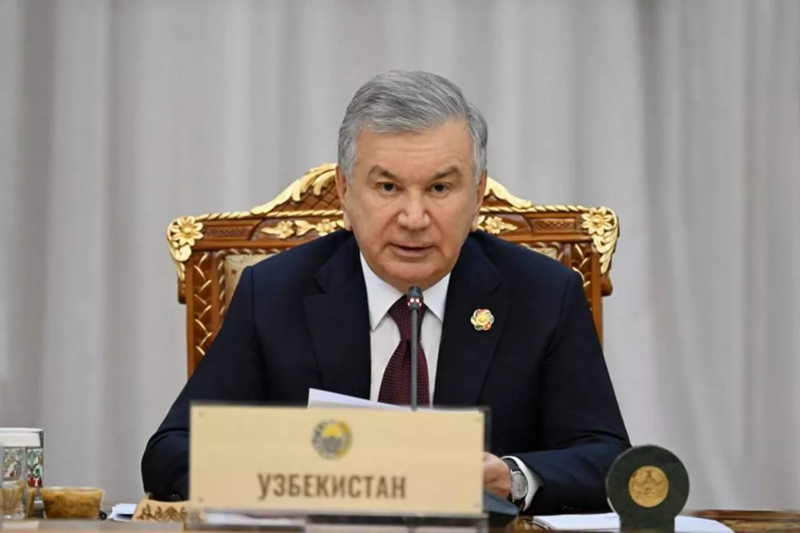
On 15 January, Uzbekistan held a high-level meeting chaired by President Shavkat Mirziyoyev focused on reviewing the activities of the Ministry of Foreign Affairs and defining priorities for the country’s external policy amid rapidly changing global conditions. The discussion addressed key challenges related to geopolitics, economic diplomacy, and Uzbekistan’s positioning in the international arena.
M.Imomov, Strategic Focus political analyst: Uzbekistan is pursuing a balanced and cautious policy based on its national interests, without giving in to emotions or external pressure
Today, the world is clearly fragmenting into several major geopolitical blocs. On one side stands the Western bloc formed around the United States and the European Union; on the other, alternative centers led by Russia and China; alongside them is a group of developing countries striving to defend their interests independently. Competition among these blocs is precisely what is fueling sanctions, trade wars, and regional conflicts.
In such a complex environment, Uzbekistan’s foreign policy stands out in a distinctive way. As President Mirziyoyev emphasized during the meeting, at a time when “the world is undergoing sharp geopolitical changes and threats to state sovereignty are intensifying,” Uzbekistan is not blindly aligning itself with any particular bloc. On the contrary, under the leadership of Shavkat Mirziyoyev, the country is pursuing a balanced and cautious policy guided by its own national interests, without succumbing to emotions or external pressure.
This approach prevents Uzbekistan from being drawn into confrontations between major powers. Instead, it enables the country to cooperate simultaneously with partners in different directions, expand its economic ties, and preserve a path of stable and sustainable development.
- Ametov, Strategic Focus political analyst: Uzbekistan’s international engagement has increased significantly
In recent years, Uzbekistan’s activity on the international stage has grown markedly, and this process is far from accidental. In 2025 alone, President Shavkat Mirziyoyev paid high-level visits to 26 foreign countries. Moreover, for the first time in Uzbekistan’s history, the leaders of Bulgaria, Finland, Slovakia, Serbia, Jordan, and Paraguay paid official visits to the country. These facts alone demonstrate the sharp rise in international interest in cooperation with Uzbekistan.
In recent years, Uzbekistan has established strategic partnership relations with 11 countries, bringing their total number to 19, while allied relations have been formed with Kazakhstan, Azerbaijan, and Tajikistan. Today, Uzbekistan maintains diplomatic relations with 165 countries, and the number of its diplomatic and consular missions abroad has reached 60. These indicators clearly show that the country’s foreign policy is being conducted systematically and on the basis of a long-term strategy.
These achievements are undoubtedly closely linked to President Mirziyoyev’s personal initiative and active diplomatic stance. As the head of state rightly emphasized in his speech, “as a result of our open, pragmatic, well-thought-out, and proactive foreign policy, Uzbekistan is gradually becoming one of the global centers of peace and diplomacy.” Today, Uzbekistan is perceived not only as a regional actor, but also as a reliable partner on the broader international stage—open to dialogue and committed to stability.
Most importantly, this growing engagement is not limited to political contacts alone. As a result of high-level visits, investment and trade agreements worth a total of USD 160 billion were signed in 2025, foreign trade turnover exceeded USD 80 billion for the first time, and exports reached USD 33.5 billion. These figures clearly demonstrate that foreign policy is delivering tangible economic results.
In this sense, Uzbekistan’s current foreign policy activism is not merely diplomatic dynamism, but a deliberate, result-oriented strategy shaped under President Mirziyoyev’s leadership and aimed at serving the country’s long-term development.
- Zokirova,Strategic Focus political analyst: Placing economic diplomacy at the center of foreign policy is a strategically sound decision
Today, the global economy is becoming increasingly fragmented: global supply chains are being disrupted, protectionism is intensifying, and sanctions and regional crises are directly affecting economic ties. In such complex circumstances, Uzbekistan’s decision to place economic diplomacy at the core of its foreign policy is a strategically sound and timely choice.
As President Shavkat Mirziyoyev has emphasized, “economic security is the fundamental foundation of state security.” This statement underscores that foreign policy is no longer limited to political dialogue alone; it is directly linked to domestic stability, employment, and household incomes. In other words, every foreign policy decision ultimately has an impact on the country’s internal economic situation.
Practical results confirm the validity of this approach. In 2025, Uzbekistan’s foreign trade turnover exceeded USD 80 billion for the first time, while exports reached USD 33.5 billion. Foreign investment inflows also rose sharply, surpassing USD 43 billion. Most notably, exports to 75 countries increased by nearly USD 4.5 billion last year, demonstrating that Uzbekistan is expanding its foreign economic relations across a broad geographic range.
Moreover, as a result of economic diplomacy pursued under the President’s leadership, agreements on investment projects and trade contracts totaling USD 160 billion were signed within the framework of bilateral and multilateral visits. These are not just figures—they represent thousands of new jobs, the introduction of new technologies, and the development of key industrial sectors.
Uzbekistan is not passively accepting today’s global economic risks. On the contrary, by expanding exports, attracting investment, and opening new markets, it is turning these challenges into sources of domestic development. This clearly shows that economic diplomacy has become one of the central pillars of Uzbekistan’s foreign policy.
- Fayzullozoda, Strategic Focus political analyst: Overreliance on one or two directions in foreign trade is risky
Today’s global environment clearly shows that excessive dependence on one or two foreign trade directions poses serious risks. Sanctions, disruptions of transport corridors, and sharp increases in shipping costs have become painful lessons for many countries. In this context, expanding markets and diversifying trade has become not a matter of choice for Uzbekistan’s foreign policy, but a necessity.
It is no coincidence that President Mirziyoyev placed special emphasis on the markets of Northern Europe, Africa, and the Middle East in his speech. These regions are rapidly growing, have high import demand, and are open to new partners. Africa in particular—uniting more than 50 countries with a combined economic output exceeding USD 3 trillion and a consumer market expected to expand further in the coming years—opens significant opportunities for Uzbekistan.
The example of Iraq cited by the President clearly illustrates how data-driven and well-calculated this policy is. Due to insufficient domestic production, Iraq currently imports goods worth nearly USD 100 billion annually, making it a highly promising market for Uzbek producers. As a result of direct negotiations, 150 major Iraqi companies were brought to Uzbekistan; after assessing the capacity of local enterprises, they began developing concrete plans to promote Uzbek products in Middle Eastern markets.
As a result, agreements have already been reached to supply hundreds of millions of dollars’ worth of goods to Iraq. This demonstrates that Uzbekistan’s foreign policy is not about “random market hunting,” but about implementing a carefully thought-out strategy based on figures and real demand.
In this sense, expanding into Northern Europe, Africa, and the Middle East offers Uzbekistan not only new trade opportunities, but also a way to reduce sanctions and logistics risks, ensure export stability, and strengthen economic security. This approach is one of the most important and forward-looking elements of the foreign policy pursued by President Mirziyoyev.
- Qodirov,Strategic Focus political analyst: President Mirziyoyev’s approach to migration demonstrates that the human dimension is being placed at the center of foreign policy
In his speech, President Shavkat Mirziyoyev clearly articulated a fundamentally new and systematic approach to labor migration. Migration is no longer viewed merely as a social problem or a forced necessity. On the contrary, if properly managed by the state and organized on a legal basis, it is increasingly seen as a major economic and social opportunity. The President’s statement that “an ambassador is a state representative who creates conditions for legal labor migration” precisely reflects this philosophy.
Today, it has been noted that citizens of Uzbekistan are working in more than 30 countries under organized labor migration schemes. Previously, this figure was limited to just two or three countries. For example, companies from Germany, Japan, and South Korea—facing labor shortages—have begun opening training centers directly in Uzbekistan to prepare local citizens for employment. A clear illustration of this is the project launched in cooperation with Japan to recruit 10,000 Uzbek specialists. The practice of sending seasonal workers to the United Kingdom has also taken on a systematic character.
This approach aims to transform migration from “spontaneous departure” into a model of high-income, skilled, and legal employment. In other words, citizens should not go abroad undocumented and unprotected, but instead receive prior training, learn languages and professions, and work on the basis of clear and formal contracts.
At the same time, the President’s speech placed strong emphasis on another critical aspect of migration: the protection of citizens’ rights. At a time when many countries are tightening their migration policies and increasing raids and inspections, this issue has become especially pressing. The President stated clearly: “Ambassadors and consuls must provide qualified legal assistance in every case and protect the rights and interests of our citizens abroad.”
This requirement means that the state will not leave its citizens alone when they are abroad. Ambassadors are now expected to move beyond “cabinet diplomacy” and visit construction sites, dormitories, and university classrooms, addressing people’s real problems on the ground. In addition, the establishment of free call centers for citizens who find themselves in difficult situations abroad further strengthens the state’s sense of responsibility.
Overall, President Mirziyoyev’s approach to migration demonstrates that the human factor is being placed at the forefront of foreign policy. Migration is no longer viewed merely as a statistical figure, but as an issue directly linked to people’s livelihoods, incomes, and future prospects. This clearly highlights the social and humanitarian dimension of Uzbekistan’s foreign policy.