By Dr Majid Khan (Melbourne):
The Islamabad talks ended without a deal. Two weeks later, the U.S. envoys cancelled their return trip, the naval blockade tightened, and Iran’s foreign minister flew to Moscow. This is not a diplomatic process winding down. It is a war by other means and the question of who blinks first has never been more consequential.
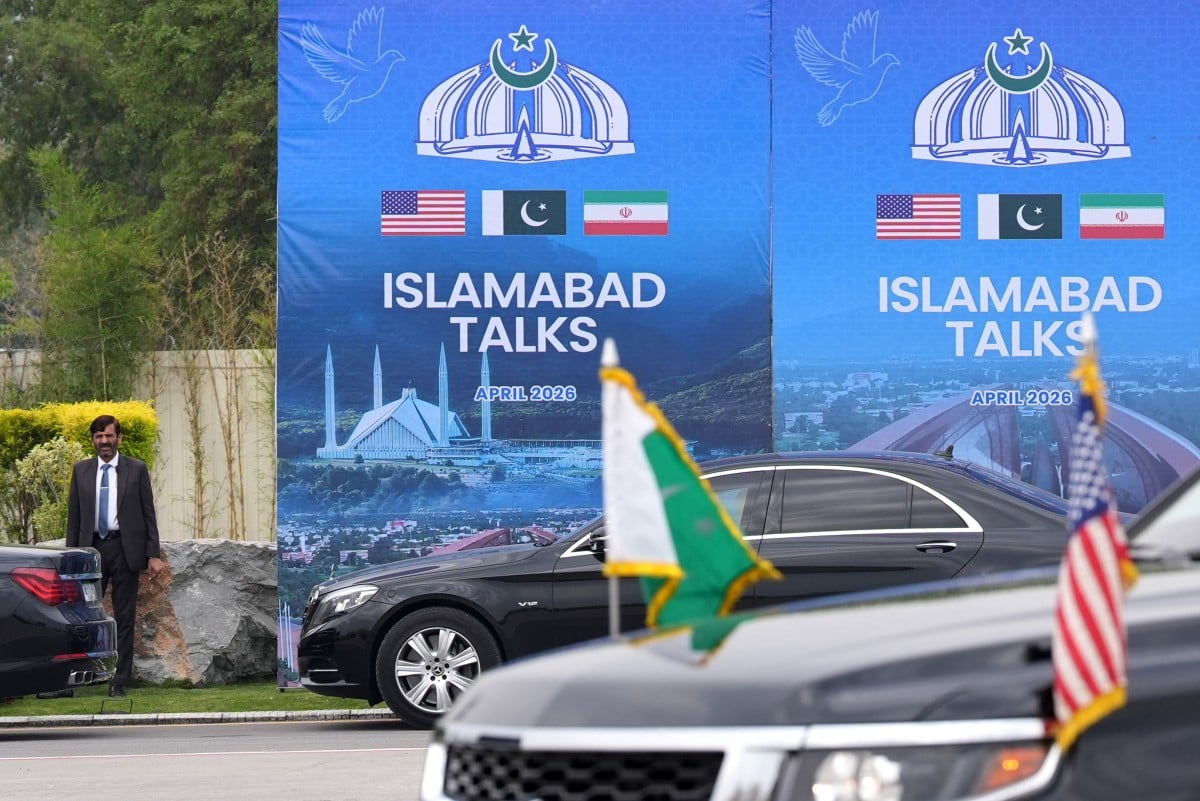
Vice President JD Vance arrived at Nur Khan Air Base with a 300-member U.S. delegation that included special envoys Steve Witkoff and Jared Kushner. Iran’s 70-member team, led by parliamentary speaker Mohammad Bagher Ghalibaf and Foreign Minister Abbas Araghchi, had landed the previous night, their air force escort switching off its transponders over Pakistani airspace. The Iranian delegation had posted photographs on social media of empty seats on their plane filled with bloodied belongings and photographs of schoolchildren killed in a U.S. missile strike a gesture that told you everything about the atmosphere before a single word had been spoken.
Within hours of Vance’s departure, Trump moved from diplomatic pressure to economic warfare. On 13 April, he announced a full U.S. naval blockade of Iranian ports. “Effective immediately,” he posted on Truth Social, “the United States Navy, the Finest in the World, will begin the process of BLOCKADING any and all Ships trying to enter, or leave, the Strait of Hormuz.” He described Iran’s toll-charging as “extortion” and instructed the Navy to seek and interdict every vessel in international waters that had paid a toll to Iran.
The blockade has escalated methodically since. As of 27 April, U.S. Central Command confirmed that 37 ships had been redirected by the U.S. Navy, with three vessels seized for non-compliance. One tanker, the M/V Sevan added to U.S. sanctions lists just 24 hours earlier was intercepted in the Arabian Sea and escorted back towards Iran. The blockade works on two levels simultaneously: it starves Iran of oil revenue, its primary source of hard currency, and it puts the world on notice that Washington intends to control the waterway militarily, with or without a negotiated settlement.
The economic bite is already visible inside Iran. President Masoud Pezeshkian has called on the Iranian public to conserve energy, citing the naval blockade’s stranglehold on the country’s main economic corridors. An oil storage crisis is building. Iran declared — in defiant terms that “under no circumstances” would the strait return to pre-war conditions while the blockade remained in place. That statement closed the door on the simplest possible off-ramp, and set the stage for the confrontation that has defined the two weeks since Islamabad.
On the weekend of 26-27 April, the diplomatic process appeared to come within touching distance of a second round of face-to-face talks and then collapsed again, in real time. Iranian Foreign Minister Araghchi flew to Islamabad for meetings with Pakistani mediators, and there was, briefly, a window in which it seemed Witkoff and Kushner might land in the same city. Trump cancelled their trip at the last minute.
The stated reason was travel time. “We’re not going to spend 15 hours in airplanes all the time going back and forth to be giving a document that was not good enough,” Trump told reporters outside Air Force One in Florida. “We’ll deal by telephone, and they can call us anytime they want.” Senator Lindsey Graham, one of Washington’s most hawkish voices on Iran, welcomed the cancellation and called for “firm control” over the Strait of Hormuz adding that military engagement “may be required in the short term.”
Tehran’s reading of the cancellation was predictably darker. Araghchi, in a statement from Islamabad, accused Washington of “destructive habits” insisting on unreasonable demands, frequently changing positions, using threatening rhetoric and repeatedly breaching commitments. “Iran is reassessing how to proceed with diplomacy,” he said, citing U.S. and Israeli military action and what he described as Washington’s destabilizing approach to negotiations. It was the language of a party that had not yet decided whether to walk away but was making sure the world knew it was considering it.
Even as the atmosphere darkened, Tehran moved to keep a channel open. Iran put forward a new proposal the terms of which were described to reporters by two regional officials speaking anonymously that would effectively decouple the immediate conflict from the nuclear question. Under the Iranian framework, Tehran would end its chokehold on the Strait of Hormuz in exchange for Washington lifting its blockade on Iranian ports and agreeing to a long-term or permanent truce. The nuclear programme, under this proposal, would be deferred to a future, separate round of negotiations.
The offer is likely to be rejected by Washington. It does not address what Trump has repeatedly described as the central purpose of the war ensuring Iran cannot build an atomic bomb. The proposal is also silent on Iran’s ballistic missile programme and its continued support for regional proxies. But it signals something important: Iran is drawing a distinction between what it needs now economic survival and what it is willing to bargain over long-term. It is a negotiating posture, not a capitulation. And it leaves the question of the nuclear programme unresolved in a way that suits Tehran rather than Washington.
On 27 April, Araghchi landed in St Petersburg for talks with President Vladimir Putin and Foreign Minister Sergei Lavrov. It was the most significant development in the post-Islamabad diplomatic landscape and one largely missed in Western coverage of the crisis. Araghchi briefed Putin on the Pakistan-mediated diplomatic process and what he called the “imposed war”, seeking to frame the conflict in terms of Iranian sovereignty and great-power solidarity.
Putin’s response was unambiguous. He pledged that Russia would “remain a staunch ally of Iran,” hailed how “courageously and heroically” the Iranian people were fighting for their sovereignty, and declared that Russia “intends to continue our strategic relationship.” Russian Defence Minister Andrei Belousov, meeting Iran’s deputy defence minister on the same day, said Moscow supports resolving the conflict “exclusively through diplomatic means” and is “ready to do everything possible” to help.
Russia’s potential role as a custodian of Iran’s enriched uranium stockpile has been floated as a possible bridge between the two sides’ nuclear positions. Tehran has resisted surrendering its stockpile outright; Washington has insisted it must leave Iranian soil. Moscow holding the material a precedent from the 2015 nuclear deal could theoretically satisfy both conditions. But for now, Iran maintains it will not relinquish its uranium, and Russia has not formally offered to receive it. The Moscow meetings are better understood as Iran’s effort to broaden its diplomatic coalition and signal to Washington that Tehran has options and allies beyond the Pakistan channel.
Pakistan’s mediating role has survived the post-Islamabad turbulence, but not without cost. Islamabad had expected the talks at the Serena Hotel to last several days, not less than 24 hours. The Pakistani side was, in the words of one senior official, “surprised” and somewhat embarrassed when Vance declared the talks over and boarded Air Force Two. The optics were not flattering for a country that had staked considerable political capital on the process.
And yet Pakistan remains indispensable. It is the one party that both sides continue to engage through. Araghchi’s repeated returns to Islamabad twice in 48 hours in the days after the initial talks underline that Iran regards the Pakistani channel as its primary line of communication with Washington. Pakistani Foreign Minister Ishaq Dar and Army Chief Field Marshal Asim Munir have maintained constant contact with both delegations. When Trump cancelled the envoys’ trip to Islamabad, it was Pakistan’s Prime Minister Sharif he called to explain the decision. That phone call alone tells you something about the country’s continuing role.
What Pakistan cannot do and what the failure of the original talks has made painfully clear is bridge the substantive gap between the two sides. Islamabad can facilitate meetings, carry messages, provide a secure and neutral venue. But it cannot resolve the nuclear question, force Israel to halt its campaign in Lebanon, or persuade Trump to lift a blockade that he appears to regard as his primary source of leverage. Pakistan’s mediation is, as one analyst put it, “legitimacy without leverage.”
Two weeks after Islamabad, the balance of advantage is genuinely difficult to read which itself tells you something about how evenly matched the two sides remain. The United States holds the harder cards: military dominance, control of the global financial system, the ability to starve Iran of oil revenue through the blockade. Trump has signalled that he is content to continue squeezing Iran economically while insisting Tehran make the first move. Iran’s economy is under serious pressure, its oil storage is filling, and its political leadership faces domestic tensions over the war’s costs.
But Iran’s leverage is more durable than Washington’s pressure campaign sometimes implies. The Strait of Hormuz remains, in effect, closed to normal traffic. Thousands of seafarers remain trapped in the Gulf. Trump and UK Prime Minister Keir Starmer discussed, as recently as 27 April, the “urgent need to get shipping moving again” a conversation that underlines just how far short of resolution the situation remains. The longer the strait stays closed, the more pressure accumulates not only on Iran but on the global economy, on U.S. allies in Asia and Europe, and on Trump himself ahead of domestic political pressures.
Iran’s new proposal separating the Strait from the nuclear question is an attempt to exploit that dynamic. If Washington can be persuaded to lift the blockade and reopen the strait in exchange for a truce, Iran preserves its nuclear programme for a future negotiation on better terms. If Washington refuses, Iran can point to American intransigence as the reason the global economy continues to suffer. It is a trap, elegantly laid. Whether Trump walks into it will define the next phase of this crisis.
The Islamabad talks did not bring peace. What they did was establish the architecture of a negotiating process positions staked, red lines drawn, and channels opened that has continued to function even as the headlines have been dominated by naval blockades and cancelled trips. Iran’s Foreign Minister is conducting shuttle diplomacy across three continents. Pakistan’s mediators are still in the room. Both sides have left open the possibility of further direct talks, even as they exchange threats.
The ceasefire extended by Trump on 21 April without a fixed deadline, pending an Iranian proposal remains the fragile floor beneath the entire process. Its continued existence, however violated at the margins, is the single most important fact in a landscape otherwise dominated by escalation. It suggests that neither side has yet concluded that the costs of resumed all-out war are worth bearing. That calculus could change.
Araghchi told Pakistani officials, before departing for Moscow, that Tehran intends to engage with the mediation process “until a result is achieved.” Nobody from either side has declared the diplomatic process dead. In the diplomacy of existential conflicts, that is not nothing. But as the naval blockade tightens, as Iran’s economy strains, and as Trump’s patience for a process yielding no visible concessions visibly thins, the window for a negotiated outcome is narrowing with each passing week.