- Rahman succeeds the interim administration that governed the 170-million-strong nation for 18 months following the ouster of former prime minister Sheikh Hasina’s government.
DHAKA, Bangladesh — Prime Minister Tarique Rahman was sworn into office on Tuesday, taking charge of Bangladesh’s first elected government since the deadly uprising of 2024.
Rahman, 60, now faces the immediate challenges of restoring security, bridging deep political divisions, and revitalizing an economy shaken by months of turmoil. Bangladesh, a nation of 170 million people and the world’s second-largest garment exporter, has been governed by an interim administration for the past 18 months following the overthrow of former prime minister Sheikh Hasina.
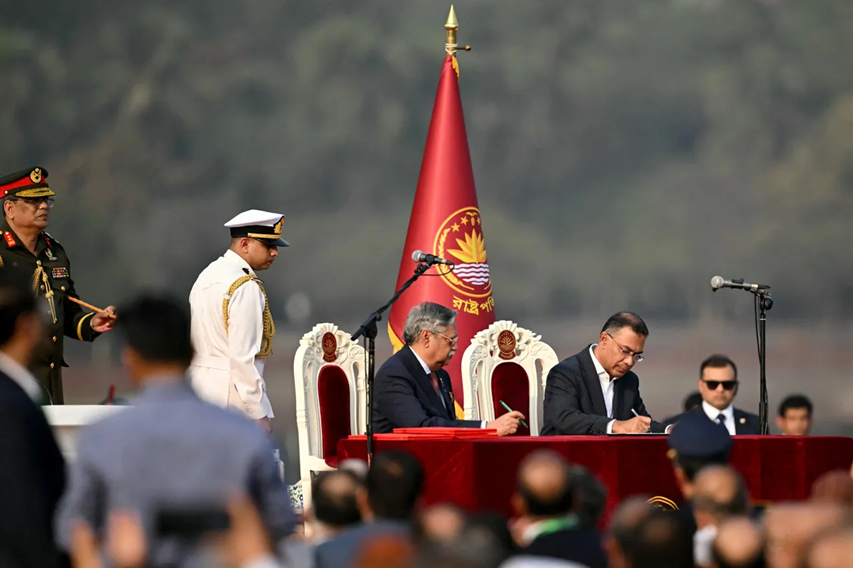
“I will faithfully discharge the duties of the office of prime minister of the government, in accordance with the law,” Rahman said during a swearing-in ceremony held outside the parliament building and broadcast live on state television. He took the oath before President Mohammed Shahabuddin.
Rahman, leader of the Bangladesh Nationalist Party (BNP) and heir to one of the country’s most prominent political families, secured a landslide victory in the February 12 elections. In his victory address, he described the result as a triumph for democratic aspirations.
“This victory belongs to Bangladesh, belongs to democracy,” Rahman said. “This victory belongs to people who aspire to and have sacrificed for democracy.”
The new prime minister has pledged to restore political stability and revive economic growth after a prolonged period of unrest that unsettled investors and weakened public institutions.
“We are about to begin our journey in a situation marked by a fragile economy left behind by the authoritarian regime, weakened constitutional and statutory institutions, and a deteriorating law and order situation,” Rahman said, calling for unity in a country polarized by years of political rivalry.
Following Rahman’s oath, members of his cabinet were sworn in. Earlier, newly elected lawmakers took their oaths before Chief Election Commissioner AMM Nasir Uddin, after which BNP members formally selected Rahman as their parliamentary leader.
Rahman’s return to power marks a dramatic political comeback. He returned to Bangladesh in December after spending 17 years in exile in the United Kingdom.
According to official results, the BNP-led coalition secured 212 seats in parliament, compared with 77 seats won by the Jamaat-e-Islami-led alliance. Jamaat, which significantly increased its representation, has challenged results in 32 constituencies but has pledged to act as a “vigilant, principled, and peaceful opposition,” according to party leader Shafiqur Rahman.
The Awami League, led by former prime minister Sheikh Hasina, was barred from contesting the election. Hasina, 78, who was sentenced to death in absentia for crimes against humanity, issued a statement from India denouncing the vote as “illegal.” India, however, congratulated the BNP on its decisive victory, signaling a shift after previously strained relations.
Only seven women were directly elected to parliament, though an additional 50 reserved seats will be allocated proportionally among parties. Four members of minority communities won seats, including two Hindus in the Muslim-majority nation.
Despite political tensions and isolated clashes during the campaign period, election day passed without major unrest, and the country has responded to the results with relative calm.
Analysts say economic recovery will be central to Rahman’s success. “If the BNP can do a good job with the economy, it will make everything else easier for the government,” said Thomas Kean of the International Crisis Group. “It will help create stability and address the broader challenges facing the country.”
Rahman now begins his tenure amid high expectations that his government can consolidate democratic reforms and steer Bangladesh toward political and economic stability.