

Dr Majid Khan (Melbourne):
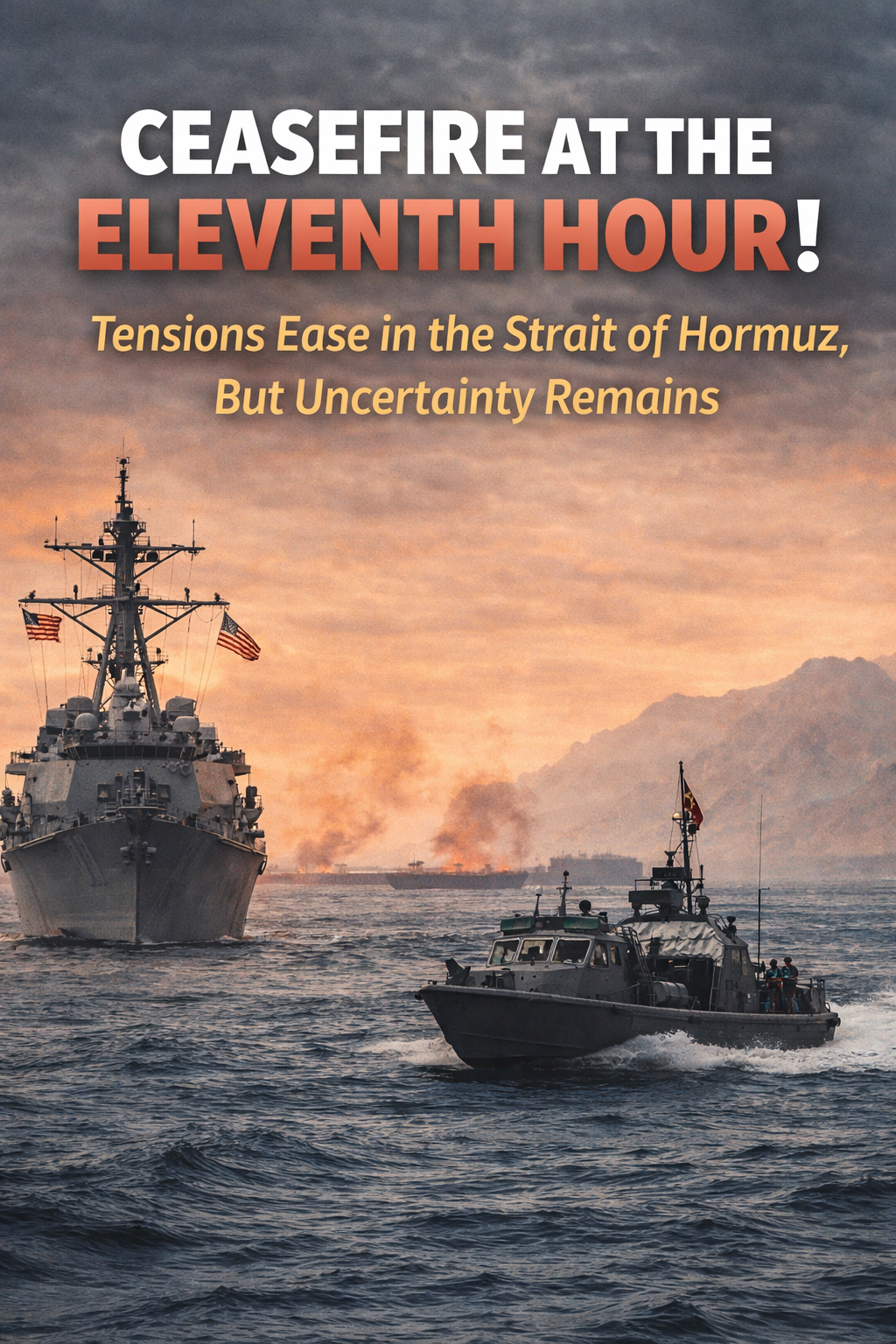
At 8 p.m. Eastern Time on Tuesday, 7 April 2026, the world held its breath. President Donald Trump had set a deadline: Iran must agree to reopen the Strait of Hormuz or face what he described as the obliteration of a “whole civilization.” Critics warned such a strike would constitute a war crime. Iran’s Revolutionary Guards had their fingers on the trigger. For 39 days, bombs had fallen on Tehran, missiles had rained down on Gulf capitals, and the global economy had been convulsed by an oil shock not seen since the 1970s.
Then, with barely an hour and forty minutes to spare, a ceasefire was announced. Trump declared it a “total and complete victory.” Iran’s Supreme National Security Council called it an “enduring defeat” for Washington. Both were claiming the same piece of paper. That alone tells you everything about how fragile this truce really is.
The two-week ceasefire, brokered by Pakistan, marks the end of the first phase of a war that began on 28 February 2026, when the United States and Israel launched nearly 900 strikes against Iran in a single 12-hour window. What follows is not peace. It is the hardest negotiation in a generation one that will determine whether the Middle East stabilizes or descends into a longer, more catastrophic conflict.
The road to this ceasefire began not with bombs, but with letters. On 12 April 2025, Iran and the United States embarked on a series of negotiations aimed at reaching a nuclear agreement, following a direct letter from President Trump to Iran’s Supreme Leader Ali Khamenei. The first rounds of talks, held in Oman and Rome, were described by both sides as “constructive.”
But the gap proved unbridgeable, Iran insisted on its right to enrich uranium. The United States demanded zero enrichment. By the time a third round of talks took place in Geneva in late February 2026, Iran’s Foreign Minister Abbas Araghchi declared a “historic” deal was “within reach.” Oman’s mediators said the same. Then the bombs fell anyway.
On 2 March, an IRGC commander declared the Strait of Hormuz closed. Over 150 tankers dropped anchor. Global oil prices surged past $100 a barrel, hitting $126 at their peak. The world’s most important shipping lane had become a weapon.
The six weeks that followed were among the most violent in the Middle East since the Second World War. The United States and Israel struck Iran’s military installations, leadership structures, and nuclear facilities. Iran retaliated with hundreds of ballistic missiles and thousands of drones, targeting U.S. military bases, Israeli territory, and the energy infrastructure of Gulf states that had offered Washington access to their soil.
At least 1,497 people have been killed since the war erupted, including 57 health workers. Among the dead is Iran’s Supreme Leader Ayatollah Ali Khamenei, killed in Israeli airstrikes on the first day of the war. Iranian officials described the attack as crossing every red line in modern statecraft. The psychological and political weight of that single strike shaped every subsequent moment of the conflict.
The war did not stay inside Iran’s borders. Israeli forces widened operations into Lebanon, displacing more than a million people. Gulf states including Kuwait, Bahrain and the UAE came under Iranian drone and missile attacks strikes that continued even after the ceasefire was announced on Wednesday morning, in an early test of the truce’s durability.
The ceasefire did not emerge from a conference room. It was stitched together overnight, in a frantic round of phone calls between Pakistan’s army chief Field Marshal Asim Munir, U.S. Vice President JD Vance, special envoy Steve Witkoff, and Iranian Foreign Minister Abbas Araghchi.
Pakistan’s role was pivotal. Unlike the Gulf states which were themselves under Iranian attack Pakistan shares a long border and deep cultural ties with Iran, is home to the world’s largest Shia Muslim population outside Iran, and hosts no U.S. military bases. It could speak to both parties with equal credibility. Prime Minister Shehbaz Sharif’s government had been quietly developing the framework of a deal for weeks, and it was Sharif who presented the final proposal to Trump on Tuesday night.
Iran put forward a 10-point proposal. The United States countered with a 15-point plan of its own. The terms of both remain only partially disclosed. What is known is that Iran’s demands include the lifting of all international sanctions, the release of frozen Iranian assets, the withdrawal of U.S. combat forces from bases across the region, compensation for reconstruction, and most controversially the right to continue uranium enrichment. The U.S. plan is believed to require Iran to surrender its enriched uranium stockpile, commit to no nuclear weapons, dismantle its regional proxy forces, and reopen the Strait of Hormuz permanently.
These two positions are not merely different. They are, on their face, incompatible. The single condition both sides agreed on last night the one that unlocked the ceasefire was the reopening of the Strait of Hormuz for safe passage during the two-week period. Everything else remains unresolved.
The way each side has framed the ceasefire reveals how far apart they remain. Trump announced it on Truth Social as a “double sided CEASEFIRE,” adding later: “There will be no enrichment of uranium, and the United States will, working with Iran, dig up and remove all of the deeply buried nuclear ‘dust.'” He described it as “a big day for World Peace.”
Iran’s Supreme National Security Council issued its own statement simultaneously, declaring that it had forced the United States to accept Iran’s 10-point plan as the basis for negotiations, and describing the outcome as an “enduring defeat” for Washington. It also included, in versions distributed in Farsi, a clause asserting Iran’s “acceptance of enrichment” a phrase Washington conspicuously omitted from every public statement.
Vice President JD Vance, speaking in Budapest, called it a “fragile truce” and warned that factions within Iran’s government were “lying” about what had been agreed. U.S. Defence Secretary Pete Hegseth was blunter still, saying American forces were watching Iran’s uranium stockpile closely and would “take it” if Tehran refused to hand it over. The guns, in other words, are merely resting.
On Friday, 10 April, delegations from the United States and Iran are expected to meet in Islamabad for the first face-to-face negotiations of the conflict. The U.S. team will be led by Steve Witkoff and is expected to include Jared Kushner and Vice President Vance. Iran’s foreign minister will lead Tehran’s delegation. The venue is symbolic: neutral, Muslim-majority, trusted by both parties, and far from the wreckage of the Gulf.
Iran expert Trita Parsi put the stakes plainly: “Trump’s failed use of force has blunted the credibility of American military threats, introducing a new dynamic into U.S.-Iran diplomacy. Washington can still rattle its sabre. But after a failed war, such threats ring hollow.” His reading suggests the balance of power entering Islamabad may be less favourable to Washington than the victory language implies.
Israel, meanwhile, is a complicating wildcard. Prime Minister Benjamin Netanyahu endorsed the ceasefire but immediately declared it did not include Lebanon, where Israeli forces continued airstrikes even as the ink on the agreement dried. Netanyahu reportedly expressed concern to Trump about a potential deal before the announcement, and a senior Israeli official confirmed that the United States had privately assured Israel it would demand Iran hand over its enriched uranium and commit to dismantling its ballistic missile programme. Whether those assurances survive the Islamabad talks is another matter entirely.
For ordinary people across the Middle East and Asia, the ceasefire announcement brought immediate if cautious relief. Oil prices plunged more than 17% following the news. Stock markets in Asia surged. In Tehran, crowds gathered at Enqelab Square to celebrate, many waving Iranian flags. In the Philippines, where diesel prices had nearly doubled during the crisis, the news was met with exhausted gratitude.
But the first ships attempting to transit the Strait of Hormuz on Wednesday a Greek-owned bulk carrier among them found hundreds of vessels still trapped in the Persian Gulf, including 426 tankers, 34 LPG carriers and 19 LNG vessels. The Strait may be notionally open. The backlog of a six-week closure will take weeks, perhaps months, to clear.
In Islamabad on Friday, two delegations will sit down across a table from each other for the first time since this war began. One will have come from a country that has been bombed for 40 days. The other from a superpower that spent $10 billion in six weeks and did not achieve its central objective. Both will arrive claiming victory. Neither will find it easy to give ground.
The world watched the Strait of Hormuz close. It is now watching, with equal anxiety, to see whether the men who meet in Islamabad have the wisdom and the mandate to build something more durable than a two-week pause. The clock is already running.