


By Adam Hancock (Singapore)
China’s nuclear posture has historically been defined by restraint, with a small arsenal and a declaratory policy emphasizing defensive deterrence. Since conducting its first nuclear test in 1964, Beijing has adhered to a “no-first-use” (NFU) pledge, committing never to initiate nuclear strikes under any circumstances and extending unconditional assurances against using or threatening nuclear weapons toward non-nuclear states or nuclear-weapon-free zones. This policy, unique among the five recognized nuclear-weapon states under the Nuclear Non-Proliferation Treaty (NPT), positions China as a proponent of minimal deterrence—maintaining only the forces necessary for assured retaliation—while avoiding arms races with superpowers like the United States and Russia.
As of late 2025, Chinese officials continue to reaffirm NFU unequivocally. In a November 2025 white paper on arms control, disarmament, and nonproliferation, Beijing described the policy as a cornerstone of its self-defensive nuclear strategy, aimed at reducing the role of nuclear weapons in national security. Foreign Ministry statements and contributions to P5 (permanent UN Security Council members) dialogues echo this, with China promoting mutual NFU agreements among nuclear powers as a practical step toward risk reduction. Despite persistent Western speculation about potential ambiguities in crisis scenarios—such as conventional attacks on nuclear assets or heightened tensions over Taiwan—no official shift has occurred. China frames NFU not merely as doctrine but as diplomatic signaling, portraying itself as a responsible actor critiquing more offensive postures elsewhere.
Yet this doctrinal continuity contrasts sharply with the rapid modernization and expansion of China’s nuclear forces, marking the most significant buildup in its history. Independent estimates from sources like the Stockholm International Peace Research Institute (SIPRI), the Bulletin of the Atomic Scientists, and the U.S. Department of Defense converge on approximately 600 operational nuclear warheads as of mid-2025, up from around 500 the previous year and more than double the figure from 2020. Projections suggest growth to over 1,000 by 2030 and potentially 1,500 by 2035, with annual additions of about 100 warheads in recent years.
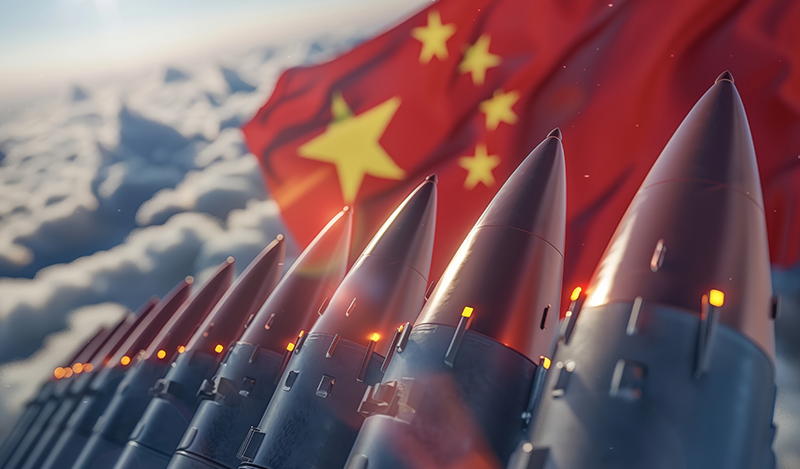
This expansion encompasses a full nuclear triad: land-based intercontinental ballistic missiles (ICBMs), submarine-launched ballistic missiles (SLBMs), and air-delivered weapons. Key developments include the DF-41 ICBM, capable of carrying multiple independently targetable reentry vehicles (MIRVs); the JL-3 SLBM with extended range exceeding 5,400 nautical miles; and nuclear-capable H-6N bombers equipped with air-launched ballistic missiles. China has constructed hundreds of new ICBM silos—around 350 completed or nearing completion by early 2025—across multiple fields, with reports indicating over 100 missiles loaded in some sites. Hypersonic glide vehicles, such as those on the DF-17 and DF-27, enhance penetration against missile defenses, while investments in early-warning systems suggest potential shifts toward higher alertness or launch-on-warning postures.
Beijing justifies these advancements as defensive responses to external threats, particularly U.S. ballistic missile defenses, precision conventional strikes, and regional alliances that could erode China’s second-strike credibility. Officials insist the arsenal remains the “minimum level” required for security, far smaller than U.S. or Russian stockpiles, and focused on survivability rather than parity or warfighting. Nonetheless, the scale raises questions about whether modernization subtly erodes strict reliance on NFU, potentially enabling more flexible options in protracted conflicts.
China’s engagement with global nuclear regimes reflects this dual approach: advocacy for disarmament alongside safeguards for its deterrent. As an NPT signatory since 1992, China supports the treaty’s pillars—nonproliferation, disarmament, and peaceful uses—advocating a “step-by-step” process where the United States and Russia, holding over 90 percent of global warheads, bear primary responsibility for deep cuts. Beijing participates in NPT review conferences and P5 processes, but resists trilateral arms control talks until arsenal disparities narrow.
On the Treaty on the Prohibition of Nuclear Weapons (TPNW), adopted in 2017 and entering force in 2021, China aligns with other nuclear states in non-participation. While endorsing its humanitarian goals and long-term vision of abolition, Beijing argues the treaty diverges from security realities, lacks nuclear-state involvement, and risks undermining the NPT. China boycotted negotiations and votes against related UN resolutions, favoring incremental, inclusive measures that preserve stability.
These dynamics profoundly affect strategic stability, particularly in East Asia, a region of intensifying competition. China’s growing capabilities intersect with U.S.-China rivalry, Indian modernization, North Korean provocations, and alliance enhancements by Japan and South Korea. Fears of miscalculation—over Taiwan or the South China Sea—grow as thresholds blur amid advanced conventional and nuclear integration. Missile defense advancements by adversaries may spur further Chinese diversification, perpetuating security dilemmas.
Globally, China’s trajectory challenges traditional arms control frameworks, long bipolar and U.S.-Russian focused. Expansion risks fueling multipolar races, eroding NPT disarmament obligations, and complicating negotiations. Transparency deficits—China discloses little about arsenal details—breed misperceptions. Yet opportunities exist: NFU’s persistence could model risk reduction, and China’s multilateral advocacy might bridge nuclear and non-nuclear divides if paired with reciprocal steps.
In conclusion, China’s nuclear doctrine balances historical restraint with adaptation to a contested environment. NFU and minimalism endure declaratively, bolstered by 2025 reaffirmations, but unprecedented modernization signals resolve for credible deterrence amid perceived vulnerabilities. For global disarmament, this presents paradoxes: expansion undermines momentum, yet China’s positions highlight superpowers’ obligations. Sustaining stability demands inclusive dialogue—P5 mechanisms, crisis communications, and eventual multilateral talks—addressing mutual concerns. Without such efforts, evolving capabilities risk escalating competition over cooperation, heightening nuclear dangers in an already volatile world. As 2025 closes, the international community must prioritize confidence-building to ensure China’s rise contributes to, rather than destabilizes, enduring peace.
Note:This article is produced to you by London Post, in collaboration with INPS Japan and Soka Gakkai International, in consultative status with UN ECOSOC.