

By Utkir Alimov,Deputy Editor UzA
In recent years, Uzbekistan has consistently expanded its international cooperation, strengthening ties with countries that play a key role in implementing major infrastructure projects to access new export markets.
Among these countries is Pakistan – a state with strong economic development potential and the second-largest population in South Asia. With Pakistan’s participation, Uzbekistan plans to implement a large and promising infrastructure project – the construction of the Trans-Afghan railway corridor.
In March 2022, the President of Uzbekistan paid an official visit to Pakistan. During the visit, both sides reaffirmed their intention to deepen the strategic partnership and expand cooperation in trade, economic, and humanitarian spheres.
In February 2025, Shehbaz Sharif paid an official visit to Uzbekistan. The parties discussed mechanisms to expand bilateral cooperation in trade, industry, and transport, and agreed to establish a Strategic Partnership Council at the highest level.
According to the Center for Economic Research and Reforms, a most-favored-nation regime is in effect in trade between Uzbekistan and Pakistan, and agreements on preferential and transit trade have been signed, creating additional conditions to increase trade turnover.
Bilateral Trade Dynamics
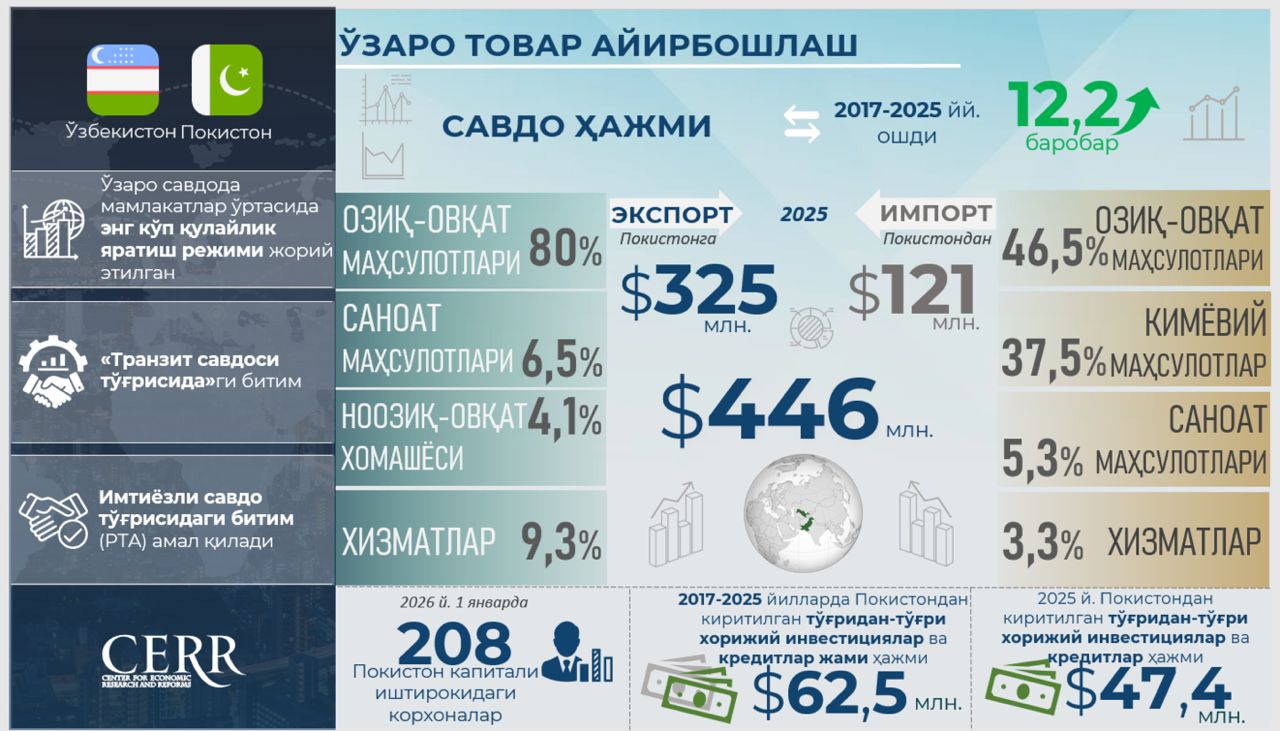
Between 2017 and 2025, trade turnover between Uzbekistan and Pakistan increased 12.2-fold, reaching $445.9 million by the end of 2025. Over the same period, Uzbekistan’s exports to Pakistan grew 32-fold to $325 million, while imports from Pakistan rose 4.6-fold to $120.9 million. The rapid growth of export supplies enabled Uzbekistan to maintain a favorable foreign trade balance with Pakistan starting from 2019.
In 2025, Uzbekistan’s exports to Pakistan included food products (dried legumes, nuts, and peanuts) – $260.2 million (80%), industrial goods (yarn) – $21.2 million (6.5%), non-food raw materials – $13.2 million (4.1%), and services (mainly transport) – $30.1 million (9.3%). As for imports, food products (meat, potatoes, citrus fruits) amounted to $56.2 million (46.5%), chemical products (pharmaceuticals, detergents, and cleaning agents) – $45.3 million (37.5%), and industrial goods – $6.4 million (5.3%). Services were also provided for $4 million (3.3%).
Investment Cooperation
As of January 1, 2026, a total of 208 enterprises with Pakistani capital are operating in Uzbekistan, including 18 joint ventures and 190 enterprises fully established with capital from Pakistan.
Between 2017 and 2024, the total volume of direct investment and credit resources attracted from Pakistan into Uzbekistan’s economy amounted to $62.5 million, of which $47.4 million was attracted in 2024 alone.
Investment cooperation between Uzbekistan and Pakistan is primarily developing in the manufacturing sector. Joint projects are being implemented in the food, textile, leather, and footwear, and pharmaceutical industries, as well as in transport, information and communication technologies, and engineering services.
Cooperation in the Transport Sector
One of the key factors constraining trade volume growth between Uzbekistan, Pakistan, and other South Asian countries remains the absence of direct railway links. Uzbekistan is interested in constructing the “Mazar-i-Sharif – Kabul – Peshawar” railway line with Pakistan’s participation. Implementing this project will enable the establishment of the shortest and most cost-effective transport corridor between the countries. It is expected that:
- Favorable conditions will be created for expanding mutual trade between Uzbekistan and Pakistan;
- the transit potential of the two countries will increase;
- Central and South Asia will be connected;
- Central Asian countries will gain access to the Pakistani seaports of Gwadar and Karachi.
Sustained growth in mutual trade, diversification of the export structure, expansion of investment cooperation, and the strengthening of the institutional framework demonstrate the consistent development of the strategic partnership between the two states.
Utkir Alimov, UzA