By Dr Majid Khan (Melbourne) & Uzair Ahmed (Islamabad):
The polling stations opened in Muzaffarabad on the morning of 2 August 2026 to largely empty streets and shuttered shops. The city had been under a curfew since early June. Banking services were suspended. Mobile networks were cut. Hundreds of civil society activists were in detention. The most prominent local protest movement had been banned under anti-terrorism legislation weeks before the first ballot was cast. And the party that had won the previous election – Imran Khan’s Pakistan Tehreek-e-Insaf, which had held 26 of the assembly’s 45 seats had boycotted the vote entirely.
This is what democracy looks like in Pakistan-administered Azad Jammu and Kashmir in the summer of 2026: a three-phase legislative election held under heavy paramilitary deployment, contested by a governing party whose legitimacy is disputed by the most organized civil movement the region has seen in years, producing results that its own chief election commissioner had to invite international observers to validate and in which the biggest winner, in a political sense, may be neither of the parties that actually won any seats.
The Jammu Kashmir Joint Awami Action Committee – universally known by its acronym, JAAC – was not formed to fight an election. It was formed in 2023 around ten demands that were unglamorous but urgent: subsidized wheat flour, cheaper electricity tariffs, investment in roads and hospitals, and an end to the lavish perks, pensions and privileges enjoyed by Azad Kashmir’s political establishment. Nationalists, traders, lawyers and local activists coalesced under its banner, and within months it had built the most broadly based popular movement in the region’s recent history.
The Pakistani government responded as it has to every JAAC mobilization since with a mixture of concession and suppression. In May 2024, Islamabad agreed to provide subsidies. In October 2024, a charter of demands signed by the Azad Kashmir government was meant to resolve most of the movement’s concerns. In September 2025, another round of protests produced another round of negotiations, with the government claiming 90 per cent of JAAC’s demands had been accepted. Each settlement proved temporary. Each time the government’s commitments were not fully implemented, the movement returned larger, angrier, and with sharper political demands.
By 2026, JAAC’s focus had sharpened onto a single, structurally significant target: the twelve seats in the Azad Kashmir Legislative Assembly reserved for displaced Kashmiris – refugees and their descendants living elsewhere in Pakistan. These “refugee constituencies” are contested not by voters in Azad Kashmir itself, but by Kashmiri diaspora populations spread across Islamabad, Punjab, Khyber Pakhtunkhwa, Sindh and Balochistan. JAAC argued, with considerable logic, that these seats give Pakistan’s major national parties – the PML-N and PPP – the ability to tip electoral outcomes in Azad Kashmir using voters who have no daily stake in the region’s governance, healthcare, water supply or electricity prices. They are, in effect, seats that allow Islamabad to manage Muzaffarabad from a distance.
JAAC demanded the seats be abolished outright or converted into representation on the Kashmir Council – the Islamabad-chaired body that exercises legislative authority over the region’s federal-facing affairs. In June 2026, the Azad Kashmir Supreme Court ruled that abolishing the seats would require a formal constitutional amendment passed by the assembly not a protest. At an All-Parties Conference in Muzaffarabad on 3 June, both compromise proposals put forward by JAAC were rejected. The stage was set for the most serious confrontation yet.
On 5 June 2026, the Azad Kashmir government banned JAAC under anti-terrorism laws, describing the organization as one that “engaged in terrorism.” Hundreds of activists were arrested. The move was extraordinary: JAAC is a civil society coalition of traders, professionals and community organizers. It has no armed wing. Its protests have included sit-ins, shutdowns and marches. The terrorism designation was not a legal description. It was a political instrument, and it produced the opposite of its intended effect.
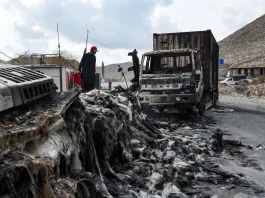
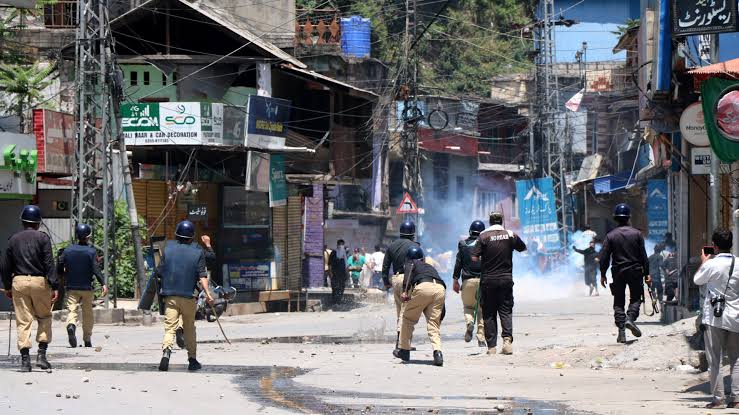
On the night of 6-7 June, law enforcement agencies attacked JAAC core committee members directly. Senior leader Umar Nazir Kashmiri was injured in the raid; his associate Shahzaib Habib was killed. The killing of Habib sparked demonstrations throughout the territory. On 8 June, clashes between police, paramilitary forces and protesters killed eleven people and injured more than seventy in and around Rawalakot. The regional government requisitioned approximately 14,000 paramilitary personnel to quell the unrest. A military helicopter crash on 11 June killed 22 people. By mid-July, at least nine more people had died in renewed clashes in the town of Rawalakot.
Through June and July, the physical geography of the crisis was centred on Rawalakot – a picturesque hill station in Poonch division, roughly 155 kilometres south of Muzaffarabad, and the administrative headquarters of the protest movement. Thousands of protesters camped in an open-air field outside the city for more than a month, maintaining a sit-in that became the symbolic heart of the uprising. In the city proper, curfew conditions prevailed. Schools, markets and banks were closed. Mobile and internet services were suspended. The information blackout that followed made it difficult for journalists and human rights monitors to verify casualty figures which themselves became disputed territory between the government and JAAC.
Amnesty International demanded a “transparent investigation” into the use of force against protesters. A solidarity rally was held in Islamabad, with hundreds of young men and women taking to the streets of the Pakistani capital in support of JAAC. Pakistan’s military spokesperson, Lieutenant-General Ahmed Sharif Chaudhry, held a press conference in which he said the state had the sole authority to use force, accused “vested interests in India” of fomenting unrest, and notably declined to mention the number of civilian casualties. India denied the allegation. JAAC dismissed it with contempt, its leaders pointing out they are a self-funded movement driven by local economic and governance grievances not a foreign-intelligence project.
The elections themselves were held in three phases specifically because of security concerns an acknowledgement, built into the electoral schedule, that normal polling conditions did not exist. Phase 1, on 27 July, covered 13 constituencies in the Mirpur division. Phase 2, on 2 August, covered eight constituencies in the Muzaffarabad division and all twelve refugee seats. Phase 3 is scheduled for 10 August, covering the remaining constituencies in the Poonch division the epicentre of the protest movement.
Phase 1 produced results that were simultaneously predictable and politically explosive. PML-N, the federal governing party of Prime Minister Shehbaz Sharif, won nine of the thirteen seats up from six in 2021. PPP won four down from eleven. PTI, which had held 26 seats and formed the previous government, won zero: it had boycotted the vote. JAAC members had been barred from standing as independent candidates. The turnout of approximately 47 per cent, while lower than the 61 per cent recorded in 2021, was described by some analysts as higher than expected given the circumstances. Polling hours were extended to accommodate a late surge.
The central dilemma of the 2026 Azad Kashmir elections is one that no electoral result can resolve: when the most popular organized political force in a territory is banned from participating, when the party that won the previous election boycotts the current one, when voters are living under curfew conditions and internet blackouts, and when the seats that determine the government’s majority are contested by people who don’t live in the territory – what does winning an election actually mean?
Hasan Askari, a political analyst, put the paradox plainly to Reuters: PML-N would likely need the support of some of the twelve refugee representatives to form a government the very seats whose existence triggered the entire crisis. “But when their government is dependent on those twelve controversial seats, how would it be able to find a solution for this issue?” he asked. It is a question that has no comfortable answer. A government formed on the basis of the refugee seats cannot, without demolishing its own parliamentary majority, abolish the mechanism that put it in power.
The third and final phase of voting, scheduled for 10 August in the Poonch division, is the most politically loaded of the three. Poonch specifically the Rawalakot area is the geographic and emotional heart of the JAAC movement. It is where thousands of protesters have camped for over a month. It is where the deadliest clashes occurred. It is where JAAC’s core leadership has been based throughout the crisis. Voter turnout in Poonch will be the most direct measurement available of how deep the boycott has cut and how much legitimacy the final result can claim.
There is an irony embedded in this crisis that is too large to ignore. Pakistan’s entire diplomatic and moral position on the broader Kashmir dispute its argument before the United Nations, its narrative to the international community, its domestic political identity rests on the claim that the people of Kashmir have been denied their right to self-determination by an occupying power. That occupying power, in Pakistan’s telling, is India.
It is therefore a matter of some significance that the summer of 2026 has produced images of Pakistani paramilitary forces firing on Kashmiri protesters, Pakistani authorities banning Kashmiri civil society organisations under anti-terrorism laws, Pakistani courts upholding electoral arrangements that give outsiders a decisive voice in Kashmiri governance, and Pakistani government spokespeople blaming India for a popular uprising driven entirely by local economic and political grievances.
JAAC leader Imtiaz Aslam stated the organisation’s position with economy: “Our fight is not with the state of Pakistan. We are only arguing against the corrupt rule of the current government here. This is what government always does, whenever anybody tries to raise voice, they allege an Indian connection.” It is a measured statement. Its implications are not. The region Pakistan calls Azad Free Kashmir is, by the testimony of its own people, governed in ways that do not feel free. That tension is older than JAAC. It will outlast this election. And it will outlast the next one too, unless the structural conditions that produced it are genuinely changed rather than electorally managed.