

By Dr.Shabnam Delfani
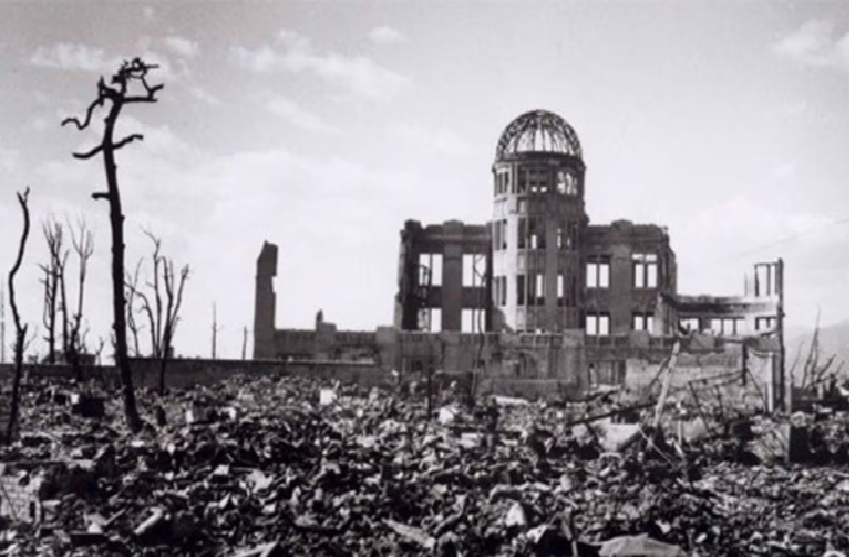
In recent days, the voices of war hawks have risen again, those who, with astonishing confidence, speak of a “Trump strike on Iran” and present it as a panacea for salvation, freedom, and development. Their argument seems simple on the surface: the United States defeated Japan in World War II, bombed it, forced an unconditional surrender, and within a few years, Japan became an economic powerhouse. So why couldn’t the same scenario be repeated in Iran?
This comparison is not only naïve but a distortion of history and more dangerously, it is a political fantasy that carries real human costs.
Let’s be blunt.
Post-war Japan was a historical exception, not an exportable model. The country that the U.S. occupied in 1945 had spent nearly eighty years on a path of deep modernization. Since the Meiji reforms of 1868, Japan had built a modern, centralized state, a universal education system, an efficient bureaucracy, a professional army, and an advanced industrial base. Before its defeat, Japan was the leading industrial power in Asia. It lost the war, but it was not institutionally hollow. It was devastated, yes, but not rootless.
What the U.S. rebuilt was erected on the foundations of a functioning modern state not on institutional vacuum.
Advocates of the notion that Iran could be “Japan-ified” often overlook crucial historical context. Japan was not a blank slate awaiting transformation in 1945; it was already a cohesive nation-state with established institutions, industrial capacity, and a distinct political culture. The United States did not create Japan from scratch. Rather, it shaped Japan’s postwar trajectory within the strategic framework of the emerging Cold War order.
The reconstruction of Japan was not an act of altruism. It was a calculated geopolitical strategy. Washington sought to position Japan as a model of capitalist recovery in Asia — a counterweight to the spread of communism. Massive financial assistance, long-term security guarantees, and preferential access to U.S. markets were instruments of ideological competition, not simply gestures of democratic goodwill.
This raises a fundamental question: where does Iran fit in today’s global strategic landscape in a way that would justify comparable investment? What overriding geopolitical threat would compel the United States to transform Iran into a showcase of its preferred order? The answer is far from clear. The contemporary international system is no longer defined by a rigid bipolar rivalry. However significant Iran may be regionally, it does not occupy the kind of front-line position in a superpower confrontation that Japan did during the Cold War.
The notion that the U.S. could transform Iran into a ‘second Japan’ reads less like a serious policy proposal and more like the treatment for a blockbuster sequel.
Moreover, post-war Japan effectively outsourced its security to the United States. Minimal military expenditure, guaranteed security, and total focus on production and export. Iran, by contrast, exists in one of the world’s most volatile regions, with overlapping regional rivalries, sectarian fault lines, deep historical distrust, and a network of state and non-state actors. Comparing an island nation in East Asia with a relatively controlled security environment to a country at the heart of the Middle East is like comparing a laboratory to a minefield.
Perhaps the most dangerous part of this narrative is the promise of “imported freedom.”
The notion that the U.S. could deliver freedom to Iranians is, if it were not tragic, laughably absurd. U.S. foreign policy, like that of any great power, is driven by interests, not ideals. The memory of the 1953 coup is still etched in the Iranian political consciousness a stark reminder that when convenience dictates, democracy is expendable. This is not an anomaly or a conspiracy; it is the logic of power.
Proponents of the “Japan-ification” scenario conveniently ignore contemporary evidence: Iraq, Afghanistan, Libya. If bombing and occupation were sufficient to turn countries into advanced economies, why did these cases fail? Why, after years of military presence, billions of dollars, and regime change, did the outcome produce nothing but chronic instability, social fragmentation, and legitimacy crises?
The answer is clear: state-building and nation-building cannot be imported through bombs. Independent institutions, political culture, social contracts, and national cohesion are products of internal, gradual processes. Sustainable development emerges from institutional order not from shock, occupation, or foreign diktat.
Development cannot be imported. Freedom is an internal project it does not arrive by missile, sanctions, or invasion. It emerges when social forces shift, elites reach consensus, a middle class gains independence, and the economy is liberated from dependence and rent-seeking. Any model that relies on an “external savior” ultimately leads to dependency, legitimacy crises, and new cycles of instability.
The problem with this comparison is not optimism or pessimism it is distortion. Distorting Japan’s history, oversimplifying global power structures, and reducing the complex process of development to a neat, packaged fantasy. When an analysis is this simplistic, one must ask: what is deliberately being left out?
To claim, “let the U.S. attack so Iran can become Japan” is neither political courage nor realism; it is a form of evading historical responsibility. Development has no ready-made formula. No foreign power can engineer a complex society, with its own history, identity, and contradictions, into a copy of East Asia. Great powers pursue their interests; if stability results, it is incidental, not the objective.
Comparing Iran to Japan, without accounting for historical, institutional, and geopolitical contexts, is no longer analysis it is propaganda. Propaganda that toys with the fantasy of “constructive destruction” while side-lining the human and social costs.
The real question is not whether Iran can become Japan. The real question is why some insist on reducing the complexity of an 80-million-strong society to a childish story: bomb, surrender, miracle development.
History is not that simple. And whenever someone tells it that way, loudly ask: who benefits from this oversimplification and deception?