

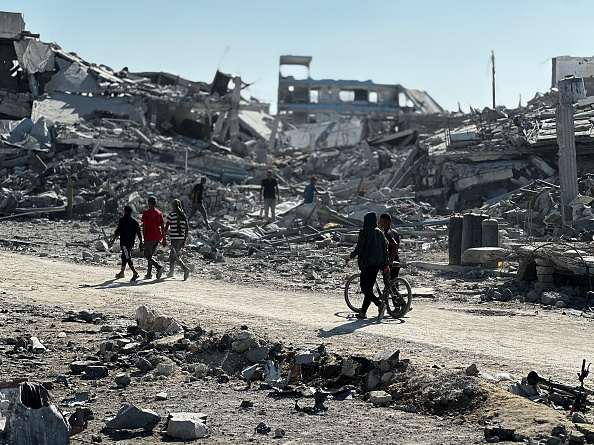
GAZA CITY, Oct 18 (Aljazeera) – In the deadliest breach of the eight-day-old Gaza ceasefire, Israeli forces killed 11 members of the Abu Shaaban family, including seven children and three women, in a tank shell attack on a civilian vehicle in Gaza City’s Zeitoun neighborhood on Friday evening, Gaza’s Civil Defence agency reported. The family was traveling to inspect their war-damaged home when the strike occurred, escalating tensions in the fragile truce brokered by U.S. President Donald Trump.
Civil Defence spokesperson Mahmoud Basal condemned the attack, stating, “The family could have been warned or handled differently. This confirms the occupation’s ongoing intent to target innocent civilians.” Rescue teams, working with the UN Office for the Coordination of Humanitarian Affairs (OCHA), have recovered nine bodies, but the remains of two children are still missing, “scattered due to the intensity of the bombardment,” according to the agency.
Hamas denounced the incident as a “massacre” and urged Trump and international mediators to hold Israel accountable for violating the ceasefire agreement. The Israeli military claimed the vehicle crossed the “yellow line”—a demarcation zone where forces were supposed to withdraw under the truce—posing an “imminent threat” after ignoring warning shots. Al Jazeera’s Hind Khoudary, reporting from Gaza, noted that many Palestinians lack internet access and are unaware of these shifting boundaries, increasing risks for civilians. Israeli Defence Minister Israel Katz pledged to clearly mark the yellow lines soon, as Israeli forces retain control over roughly 53% of Gaza.
The Gaza Media Office reported that Israel has killed at least 38 Palestinians in 47 ceasefire violations, including a prior incident last week in Shujayea, where five were killed. Israel’s blockade of the Rafah crossing and other entry points has severely limited aid, with the World Food Programme delivering only 560 tonnes of food daily—insufficient to address widespread malnutrition. The United Nations highlighted that 49% of Gazans access less than six liters of water daily, far below emergency standards.
Prime Minister Benjamin Netanyahu’s office announced Saturday that the Rafah crossing will remain closed until Hamas fulfills obligations related to returning deceased hostages. This statement came hours after the Palestinian Embassy in Egypt suggested the crossing would reopen Monday. Hamas, committed to the truce, announced it would transfer two additional captives’ bodies at 10 p.m. local time (1900 GMT) Saturday, bringing the total to 12 since the ceasefire began. Efforts to recover remains are hampered by Israel’s refusal to allow heavy machinery or international experts into Gaza, where thousands of Palestinian bodies are believed trapped under rubble.
Al Jazeera reported that the lack of equipment creates significant challenges for local teams skilled in debris recovery. Meanwhile, Israel has returned 135 Palestinian bodies under the deal, some showing signs of torture, including bound limbs and close-range gunshot wounds, according to Gaza health officials.
The incident threatens the ceasefire’s stability, with Palestinian leaders and international observers, including former Human Rights Watch director Kenneth Roth, calling for UN intervention to protect civilians. Social media posts mourned the family, with some labeling the strike a betrayal of the truce’s spirit.