

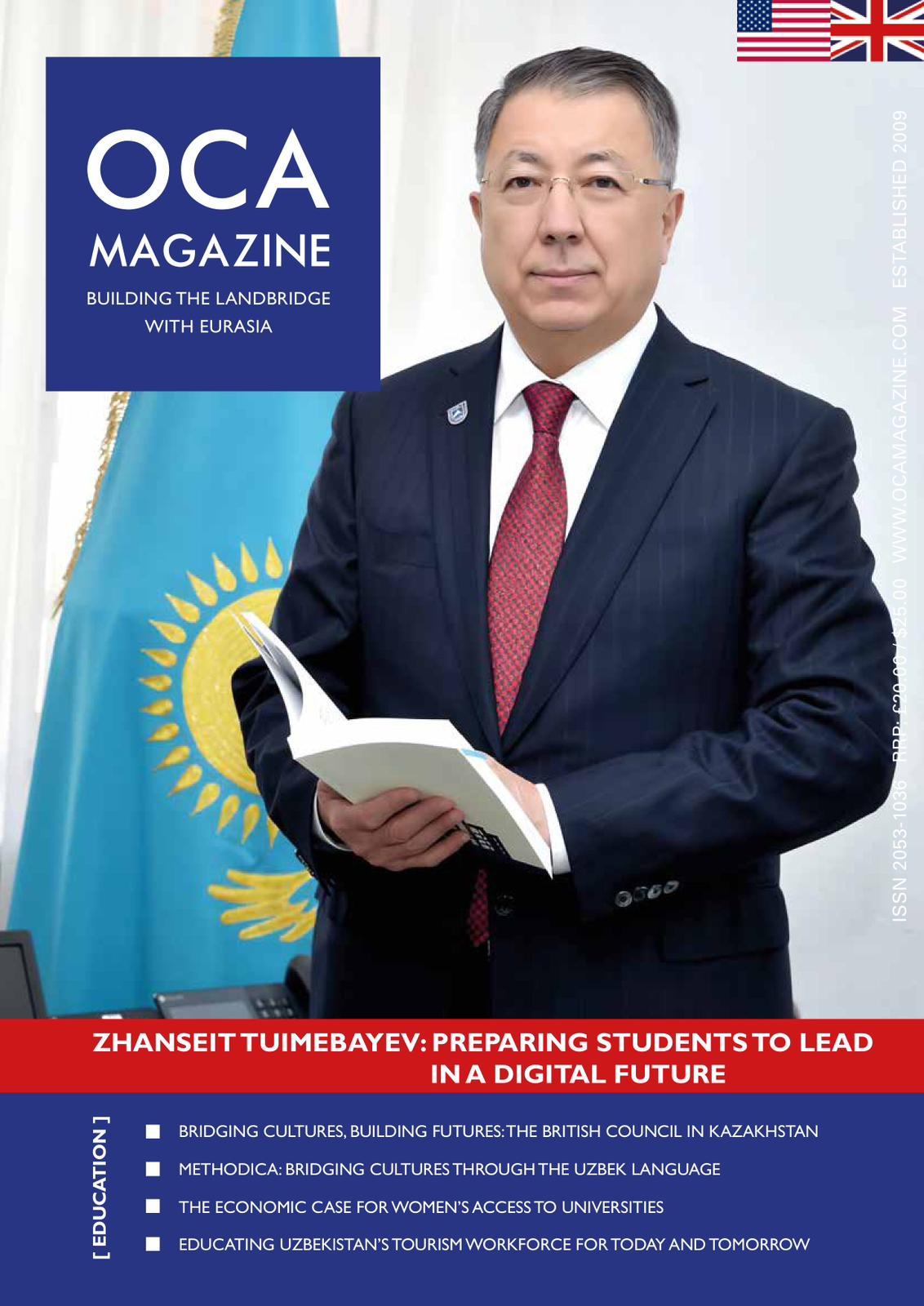
In summer 2025, the OCA Magazine (UK) released a special edition dedicated to education across Central Asia, the CIS, and neighbouring regions. OCA Magazine: Education arrives at a time of rapid digital transformation and evolving approaches to training professionals amid global competition and regional crises. The issue has already received high praise from diplomats and heads of intergovernmental organisations.
The magazine brings together expert articles, interviews with academics, and analytical reports reflecting the current state of education systems in Kazakhstan, Uzbekistan, Kyrgyzstan, and other countries of the Eurasian region. Particular attention is paid to digitalisation, the resilience of university models, access to education for women and young people in rural areas, and the search for balance between innovation and cultural identity.
The issue presents strategic success stories in modernising Kazakhstan’s leading universities – Kazakh National University and Saken Seifullin Kazakh Agrotechnical Research University. These articles showcase the integration of new educational formats, including international double degree programmes, the adoption of artificial intelligence, and the development of digital campuses. The magazine also analyses examples of effective partnerships with universities in Europe, China, and the United States.
Key topics include the impact of socio-cultural and religious factors on women’s access to higher education, the development of language education as a tool of cultural diplomacy, and the role of technical and vocational training in reducing structural youth unemployment. A highlight is an analytical contribution by leading British expert Sophie Ibbotson on educational programmes in the tourism sector. According to her projections, by 2033 tourism will provide over 290,000 direct jobs in Uzbekistan, with the total number employed in related industries exceeding 900,000. In this context, education in hospitality, international relations, and the creative industries becomes a national priority – requiring not only modernised curricula, but also new competencies, from intercultural communication to digital storytelling.
An example of such innovation is demonstrated by the Methodica School in Uzbekistan, the first centre in the country to offer immersive intensive language courses. Its programme includes travel across regions, creative labs, traditional craft workshops and cultural exploration – helping students to develop not only linguistic but broader humanistic competencies. Methodica has become a respected partner for embassies, NGOs and corporate clients, offering a flexible, multicultural approach to Uzbek language learning as a means of building dialogue.
Also featured is the Tashkent International School – the first world-class educational institution in Uzbekistan, opened over 30 years ago. It offers the International Baccalaureate curriculum to students from over 70 countries. Its mission is not only to prepare students for leading global universities, but to shape future leaders able to act in a global context with cultural awareness and respect for diversity.
The issue also highlights how Central Asian countries – including Tajikistan – are undergoing a cultural renaissance, in which music education plays a vital role not only in preserving identity but in shaping the future. This involves more than simply teaching musical notation – sustainable models are being developed, including masterclasses, international festivals, academic exchanges and new curricula. Special attention is given to composer Tolibkhon Shakhidi – a graduate of the Moscow Conservatory and one of Tajikistan’s most prominent musical figures. His work combines Eastern tonal traditions with Western academic discipline, becoming a symbol of cultural synthesis. Shakhidi not only performs internationally but plays an active role in educational initiatives, passing on the ustod–shogird (master–apprentice) tradition – a practice especially important in times of rapid modernisation. Tajikistan’s example demonstrates that sustainable development can be achieved not only through economic reform, but also through strategic investment in culture and education.
This edition also addresses the declining interest of youth in mass higher education, the need to support scientific research sectors, and the unique characteristics of business education in the region. Kyrgyzstan’s experiment with a twelve-year general education cycle also receives coverage.
The issue was prepared with the support of Hertfordshire Press and the Eurasian Creative Guild (London). Print and digital versions are distributed across universities, diplomatic missions and cultural institutions in Europe and Asia. The digital version is available on ocamagazine.com.