

By Azam Bek
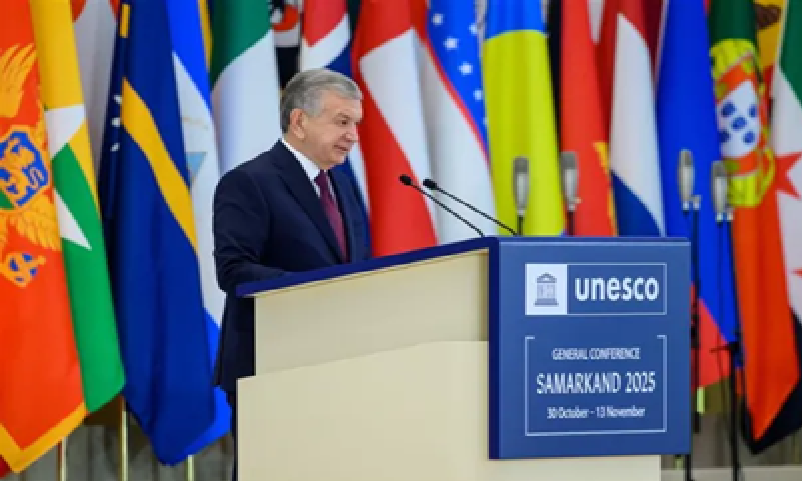
In the golden hues of late October 2025, Samarkand—eternal beacon of the Silk Road—reemerged as the pulsating heart of international cultural diplomacy. From October 30 to November 13, the 43rd session of the UNESCO General Conference unfolded amid its azure-tiled madrasas and bustling bazaars, marking a historic rupture: for the first time in over 40 years, the world’s foremost assembly on education, science, culture, and communication abandoned Paris for Central Asia. Over 4,500 delegates from all 193 member states converged, joined by presidents, prime ministers, ministers, academics, and media from every continent. Serbian President Aleksandar Vučić and Slovak President Peter Pellegrini led a constellation of dignitaries, their presence amplifying the event’s stature.
As UNESCO Director-General Audrey Azoulay declared in a mid-session interview, “We are witnessing a historic event in the life of UNESCO… here in Samarkand, at the invitation of the Republic of Uzbekistan.” With more than 180 nations represented, the ancient city—where caravans once ferried spices, silks, and philosophies—became a living metaphor for cross-civilizational dialogue. In an era riven by conflict, disinformation, and technological disruption, Samarkand 2025 was not merely a conference; it was a clarion call for unity, preservation, and ethical progress.
The Silk Road Stage: Symbolism and Archaeological Revelation
The selection of Samarkand was deliberate and profound. Recent archaeological findings, unveiled during the conference, pushed the city’s documented history beyond 2,750 years to over 3,000. “Based on scientific research and archaeological findings,” a UNESCO representative affirmed, “the first urban culture and territory were formed in Samarkand in the first millennium BC.” Artifacts and inscriptions confirm it as one of Central Asia’s earliest cultural crucibles, nurturing innovations in astronomy, mathematics, and governance long before the Common Era. This revelation elevated the venue from backdrop to protagonist, embodying UNESCO’s mission to spotlight regional heritage hubs on the global stage.
For Uzbekistan, hosting signified a post-Soviet renaissance under President Shavkat Mirziyoyev. Sweeping reforms in education, digital heritage, and cultural policy found their international debut. Egyptian analyst Ahmed Taher of the Hiwar Center observed, “Organizing such a global event is a major opportunity for Uzbekistan to assert itself… The overlap between multiculturalism and technological transformation signals that participants perceive the conference not simply as bureaucracy, but as a platform for real initiatives.”
Amid escalating geopolitical strife—heritage sites reduced to rubble in conflict zones, cultural memory eroded by disinformation—Samarkand evoked timeless resilience. Kyrgyz President Sadyr Japarov’s congratulatory address captured the regional ripple: “Holding this prestigious forum in Uzbekistan is significant not only for the country but for the entire Central Asian region… Samarkand is an ancient center of science, education, and spirituality—a bridge between civilizations.” Serbian President Vučić echoed gratitude to Mirziyoyev, hailing Samarkand as “a city striking in its history and beauty,” indispensable to world heritage guardianship.
Inaugural Resonance: Leadership, Elections, and Visionary Proclamations
The October 30 opening ceremony fused reverence with resolve. Mirziyoyev and Azoulay shared the dais, framing culture as “a bridge between civilizations and fuel for recovery after crises.” Mirziyoyev’s keynote pierced global conscience, decrying the destruction of “unique monuments, sacred sites, and priceless world cultural heritage” amid rising tensions. His call for consolidated protection resonated from Registan Square to distant capitals, cementing Uzbekistan’s humanitarian leadership.
Delegates swiftly elected Khondker M. Talha of Bangladesh as session president, ensuring diverse stewardship. The pinnacle arrived with the election of Egypt’s Khaled Ahmed El-Enany Ali Ezza as UNESCO’s new Director-General. The 54-year-old Egyptologist—professor at Helwan University for over three decades, with a French doctorate and experience in tourism academia—secured 172 of 174 votes. Assuming office on November 15, succeeding Azoulay (2017–2025), El-Enany heralds a pivot toward African and Arab priorities, emphasizing ethical innovation and equitable heritage access.
Mirziyoyev electrified the assembly with forward-looking proposals: a UNESCO Academy for Women’s Leadership, an Inclusive Education Platform for Children with Special Needs, and an International Day of Documentary Heritage. Acclaimed as “concrete steps toward universal humanistic values,” these initiatives leveraged Uzbekistan’s assets—the Center for Islamic Civilization and research hubs for Imams Bukhari, Maturidi, Termizi, and Bahauddin Naqshband—as models for interfaith and intellectual dialogue.
Threads of Innovation: Themes, Side Events, and Landmark Decisions
The agenda wove UNESCO’s enduring pillars—education rights, tangible and intangible heritage, media freedom—with pressing 21st-century imperatives. Sessions probed AI ethics, digital asset safeguarding, disinformation countermeasures, and women’s empowerment in cultural institutions. A dedicated AI-in-museums forum explored algorithmic restoration of faded frescoes alongside data-bias mitigation.
Parallel events amplified impact. The Bukhara Biennale of Contemporary Art injected visual poetry; Tashkent inaugurated the Regional Center for Preschool Education Development. The UNESCO-Uzbekistan Beruni Prize honored interdisciplinary scholars. Uzbekistan’s accession to the Global Convention on Higher Education Qualifications promised enhanced academic mobility and scientific diplomacy.
On November 3, a historic proclamation: December 15 as World Day of Turkic Languages. Co-sponsored by 26 states and led by Uzbekistan, Turkey, Azerbaijan, Kazakhstan, and Kyrgyzstan, the date honors Wilhelm Thomsen’s 1893 decipherment of the Orkhon inscriptions. Spoken by over 200 million across 12 million square kilometers, Turkic languages embody oral traditions vital to global diversity. The Turkic Culture and Heritage Foundation’s Samarkand presentation celebrated the city as their “cradle of culture and science.”
UNESCO Assistant Director-General Stefania Giannini lauded Uzbekistan’s educational vanguard. She spotlighted the inaugural Centre of Excellence in Early Childhood Care—building on a 2022 Tashkent summit—and higher education convention ratification. “The first thousand days of a child’s life are crucial,” Giannini stressed, terming the center a “concrete result.” Mirziyoyev announced a 2027 Global Conference on Skills Development and Technical-Vocational Education, targeting green transitions, digital citizenship, and lifelong learning. “Uzbekistan is investing in continuous education from cradle to career,” Gianniy affirmed, mirroring UNESCO’s vision.
Cultural interludes—symphonic crescendos, maqom virtuosos, and global fusion concerts—bridged diplomacy and artistry, embodying Uzbekistan’s ethos of exchange.
Action Beyond Words: Budgets, Boards, and Tangible Outcomes
The General Conference is UNESCO’s engine of execution. It ratified the biennial budget, elected the Executive Board, and forged actionable recommendations. Conference documents detail collaborative pipelines: AI-driven digitization of Silk Road manuscripts, anti-disinformation curricula, inclusive-education toolkits. These ensure abstract ideals germinate in classrooms, museums, and communities worldwide.
Global Ripples and Uzbekistan’s Ascendancy
For Uzbekistan, dividends cascade. The event burnished its image as a logistical titan and cultural steward, accelerating Silk Road tourism—eco-trekkers to verdant valleys, history buffs to UNESCO-listed minarets. Bilateral pacts in science, education, and heritage proliferated. As Taher noted, the fusion of “multiculturalism and technological transformation” elevates Uzbekistan from regional actor to global influencer.
Internationally, Samarkand decentralized discourse, transplanting equity and heritage debates to a locus of historical hybridity. Azoulay highlighted momentum: UNESCO’s AI ethics framework, initiated in 2018, culminates in Samarkand with neurotechnology guidelines—blending ancestral wisdom with frontier science.
A Legacy Carved in Eternal Stone
As the gavel fell on November 13, Samarkand’s echoes endured—a mosaic of speeches, elections, and accords sketching a future where heritage ignites progress. Mirziyoyev’s leadership—from women’s academies to conflict-zone safeguards—positions Uzbekistan as a humanitarian beacon. In a fractured world, the conference reminds: culture is not relic but compass.
Convening in the Silk Road’s crucible, UNESCO and its partners rekindled shared humanity’s flame. With El-Enany at the helm, the Samarkand spirit—forged in 3,000-year stone—promises a more connected, equitable tomorrow. The ancient city’s whisper is clear: dialogue, not division, charts the path forward. The seeds sown in November 2025 will shape global culture and education for generations.