


By Dr Majid Khan (Melbourne):
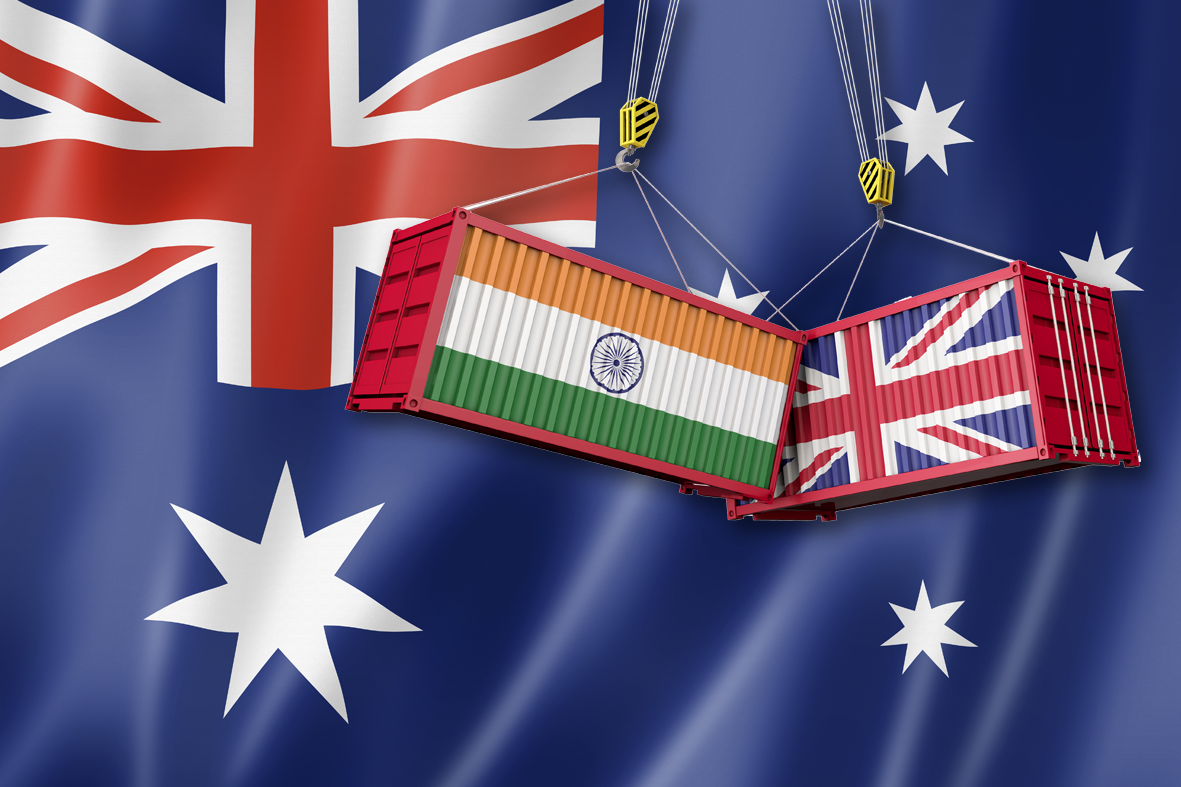
Over the past twenty-five years, India and Australia have transformed their economic ties from a modest, commodity-based exchange into a strategic partnership grounded in Indo-Pacific geopolitics, energy interdependence, and mutual efforts to de-risk from China. From trade worth less than US $3 billion in 2000 to more than US $24 billion in 2024–25, the partnership has gained not only scale but also structure and symbolism. Yet beneath the optimism lies a relationship shaped by asymmetry, price swings, and the controversies surrounding the Adani Group’s ventures in Australia.
At the start of the millennium, bilateral trade stood at just US $2.5 billion. Australia exported gold, copper, and coal, while India sold textiles and pharmaceuticals. For Canberra, India was secondary to East Asia; for New Delhi, Australia was low on the trade priority list. This changed as India’s rapid growth after 2000 created immense demand for raw materials. By 2010–11, two-way goods trade surpassed US $20 billion, with energy becoming its backbone.
The 2010s marked a strategic realignment. Prime Minister Narendra Modi’s 2014 “Act East” policy resonated with Australia’s Indo-Pacific pivot. Diplomatic relations deepened through the 2014 Framework for Security Cooperation, giving trade greater focus. By the early 2020s, both governments acknowledged the need for a structured pact to stabilise ties.
That framework arrived with the Australia–India Economic Cooperation and Trade Agreement (AI-ECTA) in April 2022, effective that December after a decade of negotiation. It scrapped tariffs on 96% of Indian exports and 85% of Australian goods, set to rise to 90% by 2026. The results were immediate: India’s exports rose 14% in FY 2023–24, and total trade jumped to US $25.9 billion in FY 2022–23—double the pre-pandemic figure. Although trade slightly eased to US $24.1 billion in 2023–24 due to weaker commodity prices, both sides aim to reach US $40 billion once a broader Comprehensive Economic Cooperation Agreement (CECA) is finalised by 2026.
Energy remains the partnership’s core. Around three-quarters of Australian exports to India consist of coal, LNG, and minerals, while India’s exports—pharmaceuticals, machinery, auto parts, and IT services—make up about one-quarter. Australia continues to post a trade surplus, estimated at A $16 billion in 2024. In FY 2025, India exported US $8.58 billion worth of goods and imported US $15.52 billion, leaving a clear deficit. These imbalances mirror both trade structure and commodity cycles: imports surged during the post-COVID resource boom but fell 4% in FY 2025 as global prices cooled.
Investment flows have added complexity to the relationship—none more so than through the Adani Group’s ventures in Queensland. Via Bravus Mining & Resources, Adani has poured roughly US $2.5 billion into the Carmichael coal mine, a 200-km rail link, and the North Queensland Export Terminal (NQXT). In April 2025, Adani Ports announced full ownership of NQXT in a US $2.54 billion deal, tightening its grip on Australia’s coal export chain.
Initially projected as a A $16 billion mega-development, the Carmichael project became one of Australia’s most divisive corporate cases. Supporters hailed it for jobs and diversification; critics condemned it as climate hypocrisy. Movements like Stop Adani drew international attention, pushing banks such as Westpac, NAB, and HSBC to exit financing. Adani eventually self-funded construction, launching shipments in 2021.
Scrutiny, however, hasn’t subsided. In 2025, The Guardian reported that Adani’s Australian units paid minimal corporate tax despite major revenues. Queensland’s government ordered royalty audits amid claims of underpriced coal sales to affiliates—allegedly costing the state millions. Adani denied wrongdoing, citing compliance and transparency. Yet the controversy reignited national debate over balancing foreign investment with fiscal accountability.
In India, the Adani narrative has taken a political dimension. The group’s rise under Modi—spanning ports, airports, and renewables—has made it both a symbol of national ambition and a lightning rod for opposition attacks. The 2023 Hindenburg Research report alleging stock manipulation wiped US $100 billion from its market value within weeks. Although investigations later ended inconclusively, the episode dented India’s corporate governance image. Further allegations in 2024 about solar contract bribery—also denied—kept Adani under the spotlight. Opposition leaders now cite the “Carmichael tax scandal” as evidence that India’s corporate giants risk tarnishing its global credibility.
Yet beyond such turbulence, the broader strategic logic remains intact. Both India and Australia are Indo-Pacific democracies seeking secure energy access, diversified markets, and reduced reliance on China. Canberra’s India Economic Strategy to 2035 (updated in 2025) labels India its “most consequential trade opportunity,” highlighting ten growth sectors from agribusiness to critical minerals. India’s own strategy mirrors this focus—prioritising lithium, cobalt, and rare earths for electric mobility and semiconductors. Trade, thus, aligns with geopolitical convergence under the Quad partnership with the U.S. and Japan.
Economic and security cooperation now reinforce each other. Australia’s re-entry into India’s mining and defence ecosystems coincides with joint naval exercises, undersea-cable initiatives, and defence-industrial collaboration. Both sides are pursuing renewable and hydrogen ventures to green their carbon-heavy trade. Canberra views this as essential to sustain public backing, while New Delhi sees it as a pillar of long-term energy security.
Persistent hurdles remain. India’s recurring trade deficit of US $8–10 billion is politically sensitive. To balance it, India must scale up high-value exports—IT, pharmaceuticals, processed agriculture—while Australia must reduce its overreliance on raw commodities. Non-tariff barriers, especially in biosecurity and certification, continue to impede access. Cooperation on digital trade, logistics, and mutual recognition agreements could ease these frictions. Managing public perception is equally vital: controversies like Adani’s must not overshadow institutional achievements such as ECTA.
As of September 2025, two-way goods trade steadies around US $25 billion, with services—education, tourism, and IT—adding another US $8–10 billion. With expansion into critical minerals and renewables, total trade could reach US $50 billion by the early 2030s. Australia’s 2025 New Roadmap for Economic Engagement with India identifies nearly fifty sectoral opportunities to propel this goal.
Ultimately, the partnership’s sustainability depends more on governance than numbers. The Adani episode has forced both nations to confront the nexus between transparency, environmental responsibility, and strategic ambition. Australia must welcome Indian capital with oversight; India must ensure its global champions uphold the same integrity abroad as it demands from multinationals at home.
A generation ago, India and Australia were distant trade partners. Today, they stand as strategic collaborators shaping the Indo-Pacific’s economic future. If they can balance commerce with credibility, this partnership could evolve into a global model—defined not by the turbulence of the Adani paradox, but by a stable synergy where growth, governance, and climate conscience coexist.