

By Lolisanam Ulugova
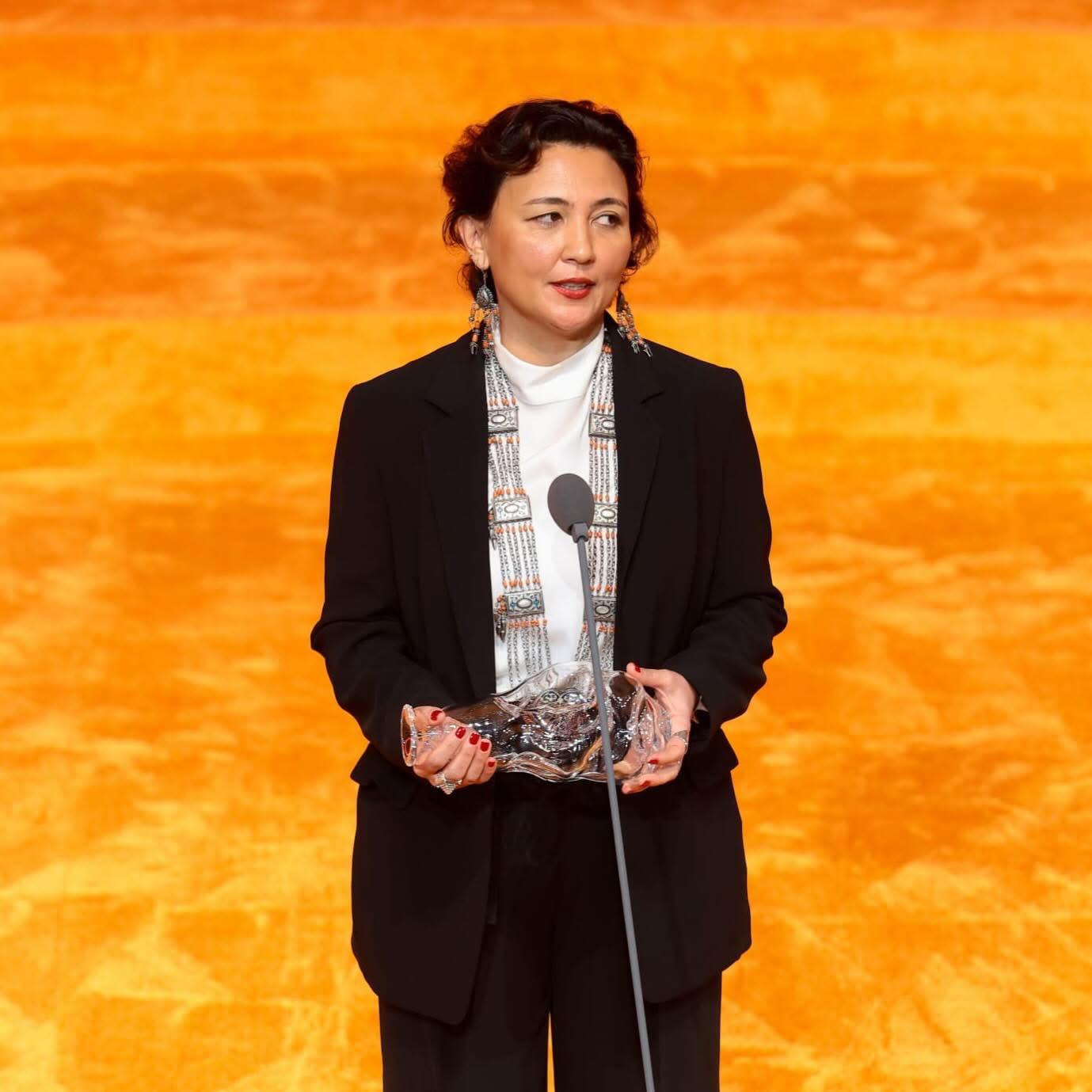
This interview with Uzbek artist Saodat Ismailova follows her recognition as a 2025 Gold Medalist in the Art Basel Awards‘ Emerging Artist category—an honor highlighting the sustained depth of her practice. Ismailova’s work, rooted in Central Asian myth, women’s histories, and ritual, moves fluidly between film, installation, and collective research. Her achievement marks a significant moment for the visibility of contemporary art from the region.
This interview moves beyond the accolade to explore her artistic trajectory, her engagement with memory, and the importance of Central Asian narratives in global art.

London Post:What works did you present at Art Basel? Could you describe the work you showed there? In this context, how would you describe your experience of taking part in major art events such as the Art Basel Award, the Venice Biennale, and Documenta 15? What are these environments like for you as an artist?
Saodat Ismailova:I received the Golden Award in the Emerging Artist category at the inaugural Art Basel Awards this year. This Award recognizes an artist’s overall practice rather than a specific work. I was first nominated, then selected as a finalist, and ultimately voted for by my peers to become the Golden Medalist.
The Award process consisted of three stages. In the first stage, observers — including curators, writers, and museum directors — nominated artists; I understand there were more than 150 names at this initial level.
The second stage involved the selection of 36 medalists across nine categories: Emerging Artist, Established Artist, Icon Artist, Storyteller, Curator, Cross-disciplinary Creator, Museum, Ally, and Patron. These medalists were chosen by a distinguished jury, including Hoor Al Qasimi, Koyo Kouoh, Hans Ulrich Obrist, Adriano Pedrosa, Elena Filipovic, among others.
The third and final stage determined the Golden Awardees, who were selected through voting by the medalists within each category.

In response to your question: the Art Basel Golden Award should not be compared to documenta or the Venice Biennale. Those are major exhibitions, whereas this is an Award — a recognition of one’s artistic practice.
LP:You grew up in post-Soviet Uzbekistan. Can you recall a single sensory memory from your childhood that still appears in your films or installations? How does this memory shape a particular work?
SI:I was ten years old when the Soviet Union collapsed. My earliest memories are tied to perestroika — the only reality I knew. Those were strange, disorienting years filled with liberation, grief, excitement, and fear. My childhood memories outside the home appear in black and white, almost colorless. Anyone who lived it will understand. It felt as if we were experiencing the consequences of a war that remained invisible yet shaped the atmosphere with suffocating heaviness.

I grew up in union building of cinematographers, just across the road from the Uzbek Film Studios. We watched it disintegrate, torn into pieces. The loss was not only material; it was human. People were suddenly expected to transform, to move into a new system they had neither chosen nor prepared for.
Academia and the arts, still operating much focused on the establishment of Soviet power in the early 20th century, not yet facing a collapse that was equally heavy and traumatic. It was a profound mental transition — waking up to a completely new reality while the familiar systems people rely on simply disappeared.
Over time, I have come to recognize that my artistic practice is, in many ways, a search for an anchor — something that can hold steady when the winds blow in every direction, through dust storms and thick fogs. My work is tied to this need for stability, a quality I observed in the older generations and in how they navigated turbulent political climates. Their endurance, their quiet forms of resilience, continue to shape the questions that guide my practice today.
LP: Your films often revive oral histories and myths. How do you choose which stories to bring into the present? And how do you know when a story is better left as an echo rather than retold directly?
SI: It seems to me that this extends from my previous answer. Oral transmission exists outside dominant state narratives; it is unfixed, alive, and continuously transforming. It is not censored, not printed, not manipulated, and not instrumentalized for propaganda. In this sense, oral transmission offers a non-aligned narrative of reality, standing in contrast to the forms of temporal fixation imposed by modernity.
Oral transmission holds a truth capable of imagining alternative futures — a reflective space for what is yet to come.
My connection to oral tradition is rooted in my grandmother. In the early years of my practice, I understood it primarily as an intergenerational transmission within female social structures. Today, I see clearly that it is not gender-bound at all. It took more than twenty years before my films began to be shown widely and received by audiences; throughout that time, I worked with full faith in what had been orally passed down to me.
It is curious how artists often arrive at ideas a decade before theoretical discourse catches up. But one must wait — affirmation, when it comes, arrives very slowly, and sometimes it does not arrive at all. Still, if an artist believes in their work, they must remain faithful to what they know, even when their ideas do not align with the demands or expectations of their time.
LP: Could you tell us about the DAVRA Collective? How did the idea emerge, and who was part of the team? What was the main goal of this collective research, and what did you explore together? Were there moments when the collective’s findings challenged your own authorship? How do you approach authorship within collaborative processes?
SI: Davra emerged from my desire to connect the region. This intention first appeared in my work Stains of Oxus (2016), when I walked along the Amu Darya, from the glaciers of the Pamir Mountains down to the Aral Sea in Karakalpakistan. At that time, it was nearly impossible for an Uzbek citizen to obtain a Tajik visa; it was easier to get a Schengen visa. These were years marked by severe political manipulation.
I remember the shock of realizing that I could not enter a neighbouring country with whom we share our only source of water — the river from which we all drink. On its surface, Stains of Oxus appears as a poetic landscape journey; on a deeper level, it is an act of reconnection with land and a water body that existed long before us and will continue long after us. Walking with the river became a gesture of flow across the region, despite borders, political tensions, and ethnic conflicts.
In 2018, I presented the multidisciplinary performance Qyrq Qyz with the support of the Aga Khan Trust for Culture. The commission came after they saw my earlier work Gulaim (2014), when I was working on the female heroic epic of Qyrq Qyz. I was drawn to this story because it exists in all five republics of present-day Central Asia. The only request from the Trust was to work with traditional musicians. I proposed working with young female traditional musicians from across the region, building a two-year educational program prior to the performance. It became another gesture of unification — not an attempt to form a single regional identity, but to nurture awareness of our shared roots and of the richness of our diversity when we remain connected. This consciousness is essential if we do not want to be hijacked by external illusions and if we wish to remain tolerant of one another. This was at the heart of Qyrq Qyz.
In 2019, the Arts and Culture Development Foundation of Uzbekistan supported my idea of creating a laboratory for young artists — CCA LAB. My intention was, again, to work cross-regionally, though at that time it had to be limited within Uzbekistan. I led the lab for one year, and engaging with artists across different disciplines — learning about their needs and missing infrastructures — brought me back to thinking about the region as a whole: its interconnections, its integrity, and the necessity of mutual support. This process ultimately led me to create Davra. It aligned with ruangrupa’s vision for documenta fifteen, and they supported my desire to form a research collective that would bring Central Asia together.
When Davra began in 2021, it was an experiment. I was not certain it would work, but I allowed it to flow and shapeshift. Now, in its fourth year, it is a joy to see the participants evolve, receive international support, and gain visibility. We have produced two films, artworks, film programs, publications, and a wide range of educational initiatives. I am proud that one of Davra’s artworks — Taming Waters and Women of Soviet Uzbekistan — has entered the collection of the State Art Museum in Łódź, Poland. Davra also questions what Central Asia is, trying to bridge not only westwards but also to rebuild our southern and eastern connections, which should slowly expand our vision over time.
For me, Davra is the realization of a decade of reflection on regional unity. And as one grows and reaches a certain stability as an artist, there inevitably comes a moment when you must give back — to offer your shoulder to those who come after us.
Regarding your question about authorship: I am not entirely sure what you mean. Davra is a platform for sharing and developing ideas collectively. What is important is that Davra is credited whenever it is engaged.
LP: And finally — perhaps a more provocative question. Some critics say that when traditional cultures are shown in big international museums, they can appear exotic or fixed in time, rather than living and changing. Do you agree with this concern? How do you make sure your work presents Central Asian rituals in a respectful and authentic way?
SI: I think the difficulty with this question lies in the assumption that tradition is something non-modern, fixed, or outside of time. I do not see tradition — especially the tradition of my home region — in the way you describe it. For me, it lives alongside time and measures time in its own way. Tradition is not the opposite of modernity, and this binary framing unfortunately stems from residual colonial Western frameworks that remain present in the region. It is a perspective that has the right to exist, but it is also one we must move beyond. It is time to be liberated from such limitations.
Lolisanam Ulugova is an independent film and theatre producer, curator, and art journalist. She holds a Master’s degree from the University of Turin and an Erasmus+ Choreomundus International Master in Dance Knowledge, Practice, and Heritage. A former Global Cultural Fellow at the University of Edinburgh and a CAAFP Fellow at George Washington University, she has contributed to Voices on Central Asia, The Diplomat, and Curator Space. Her artistic work addresses violence, inequality, and marginalized voices through theatre and film.