

By Nurmuhammad Nurmamatov
Tashkent State University of Law
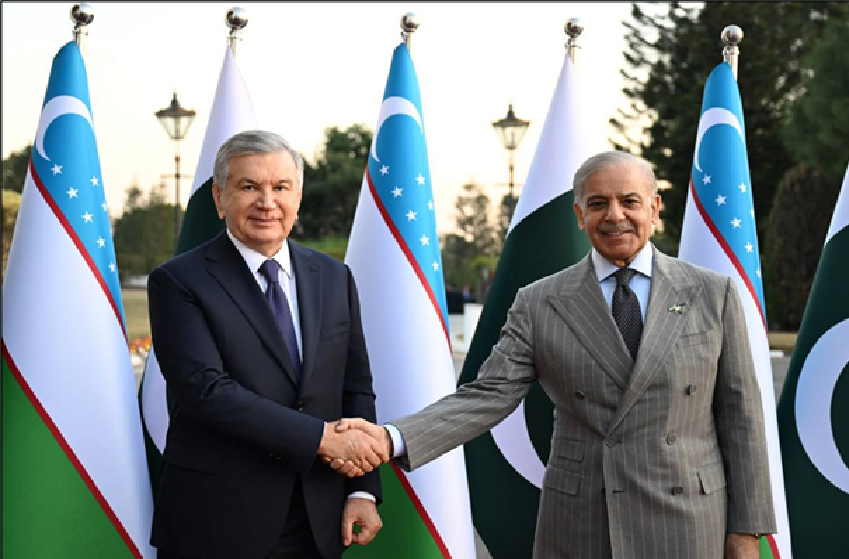
In February 2026, an important event took place in regional geoeconomics — the state visit of the President of Uzbekistan, Shavkat Mirziyoyev, to Pakistan. Alongside other key issues, major transport projects were discussed during the negotiations. During meetings in Islamabad, the parties developed concrete “roadmaps” in two main areas.
The first direction is to accelerate the Trans-Afghan railway project, which will directly connect the transport networks of Uzbekistan and Pakistan via Afghanistan. An agreement was signed to begin field studies and prepare a feasibility study — the most important step before the technological design phase.
The second direction is the creation of the “Pakistan — China — Kyrgyzstan — Uzbekistan” transport corridor. Notably, pilot cargo shipments along this route were planned as early as February 2026. This means it is not merely a declarative memorandum, but a practical test of the logistics chain’s functioning. It was agreed to establish special warehouses at the port of Karachi to service Central Asian cargo flows.
The corridor involving Uzbekistan and Kyrgyzstan is primarily aimed at linking Western China with Central and South Asia. This route is intended for containerized and high-value cargo, where speed of delivery and integration with Chinese infrastructure are crucial. In this process, Uzbekistan is emerging as a transit hub at the junction of civilizational and economic regions.
Interest in access to Pakistani seaports is not unique to Uzbekistan. However, it is important to emphasize that within the framework of economic diplomacy, our country has abandoned “zero-sum” thinking. We proceed from the realities of 21st-century Eurasian logistics — which is based not on monopoly of a single route, but on multiple complementary routes.
Through this approach, Uzbekistan is solving its strategic tasks. After 2022, northern routes came under the influence of sanctions and political risks. The corridor passing through China, Kyrgyzstan, and Pakistan creates an alternative route independent of the situation in Russia, Iran, or the Caucasus. This is not just logistics — it is transport sovereignty.
The more routes from Central Asia to Pakistani ports exist, the greater the flexibility in redistributing cargo flows. This is the efficiency of network logistics: the more connections there are, the more stable the system becomes.
In turn, as this transport corridor is implemented, Pakistan’s role as a key transit hub between Central and South Asia will increasingly strengthen. The more routes pass through its territory and ports, the greater its transit revenues, the investment attractiveness of its port infrastructure, and Islamabad’s regional geopolitical weight.
Therefore, the results of the February visit demonstrate that the geoeconomic approach has entered a qualitatively new stage. Uzbekistan and Pakistan are jointly shaping a new transport reality beneficial for all participants.
First, the portfolio of Uzbek-Pakistani investment projects is estimated at $3.5 billion. These are major investments that strengthen regional connectivity and contribute to GDP growth, job creation, technology transfer, and the consolidation of political trust.
Second, following the first meeting of the Strategic Partnership Council, President Shavkat Mirziyoyev and Prime Minister Shehbaz Sharif confirmed their firm commitment to strengthening connectivity between Central and South Asia. They also expressed readiness to continue mutual support within international and regional organizations.
Agreements were reached to expand cooperation in pharmaceuticals, light industry, electrical engineering, mining, the food industry, and agriculture. Special attention was given to developing transport and logistics links and creating favorable conditions for business. Thus, the transport corridor will not only strengthen ties but also fill them with real trade content.
Third, the project also includes Afghanistan — which for decades has been a “gap” in Eurasian logistics. A railway passing through this territory will transform the country from a barrier into a connecting link. This is not only an economic contribution but also a contribution to regional stability.
In conclusion, the February agreements reached in Islamabad are not ordinary diplomatic statements but real deals with concrete timelines. Pilot shipments, field research, construction of warehouse complexes, memoranda on multimodal transportation — all of these are practical expressions of a strategic vision. Central Asia is no longer a peripheral zone of global logistics but is becoming an active center shaping new Eurasian supply chains.
This is the shared achievement of the New Central Asia as a space of strategic rapprochement, peace, stability, trust, and cooperation.