

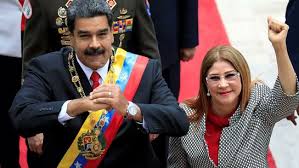
CARACAS,Venezuela. Dec 03 -Venezuela’s political crisis escalated dramatically on Saturday, January 3, 2026, when Vice President Delcy Rodríguez announced that the government had no information on the whereabouts of President Nicolás Maduro or First Lady Cilia Flores, following a series of explosions across the capital and other regions.
In an audio statement broadcast on state television, Rodríguez declared: “We do not know the whereabouts of President Nicolás Maduro and First Lady Cilia Flores. We demand immediate proof of life.”
Her remarks came shortly after multiple explosions—at least seven reported in Caracas alone—were heard in the early hours, accompanied by low-flying aircraft. Residents fled into the streets, and social media videos showed smoke rising from military sites, including Fuerte Tiuna, Venezuela’s largest military complex, and La Carlota air base. It remained unclear whether the blasts caused casualties or if civilian areas were directly hit.
More:https://londonpost.news/us-forces-capture-venezuelan-president-nicolas-maduro-in-dramatic-raid/
The United States claimed responsibility for the operation. President Donald Trump announced on Truth Social that U.S. forces had conducted a “large-scale strike” against Venezuela, resulting in the capture of Maduro and his wife, who were “flown out of the country.” Trump described the mission as successful and conducted in coordination with U.S. law enforcement, adding that further details would be provided at a press conference later in the day.
U.S. officials, including Secretary of State Marco Rubio and Attorney General Pam Bondi, confirmed that Maduro—indicted in the Southern District of New York on narco-terrorism charges—would face trial on American soil. A senior administration source indicated the capture was executed by the Army’s Delta Force unit.
The strikes followed months of escalating U.S. pressure on the Maduro government, which Washington has accused of leading the Cartel de los Soles drug-trafficking network. Recent operations included a CIA-linked drone strike on a suspected drug docking site inside Venezuela and more than 35 attacks on vessels in the Caribbean and eastern Pacific, reportedly killing at least 115 people. A major U.S. naval deployment, including an advanced aircraft carrier, had been positioned in the region since November.
Maduro, in a recorded interview aired Thursday, had accused the United States of seeking regime change to gain access to Venezuela’s oil reserves while denying involvement in drug trafficking.
A person close to the Venezuelan government confirmed that Vice President Rodríguez was safe. Under the Venezuelan constitution, she would assume interim leadership in the event of the president’s “absolute absence,” though the situation remained fluid and uncharted.
The Venezuelan government denounced the U.S. action as a “grave military aggression” and declared a national state of emergency. International reactions were swift, with allies Russia and Iran condemning the strikes, while several Latin American leaders called for de-escalation and respect for international law.
The operation marks the most direct U.S. military intervention in Latin America since the 1989 invasion of Panama.