

By Mohammad Raashid (Islamabad):
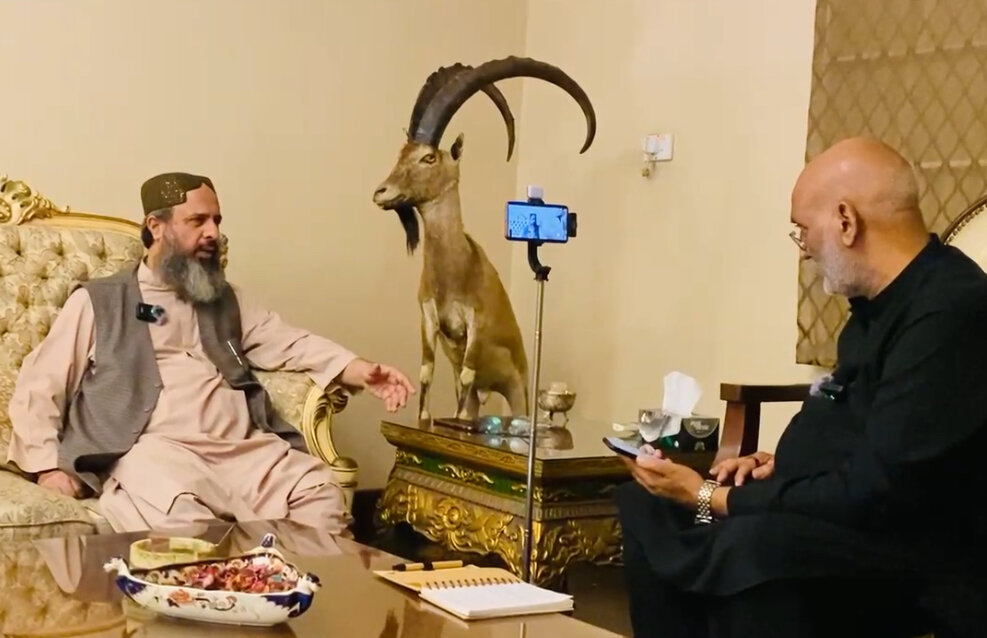
Mir Shafiq ur Rehman Mengal, a prominent tribal figure from Baluchistan often accused by separatist groups of leading a so-called “death squad,” has strongly rejected the allegation, calling it “baseless propaganda” by what he describes as Indian-backed militant organizations operating in the province.
In an exclusive interview, Mengal said the term “death squad” has been deliberately misused by armed Baloch separatist groups such as the Baloch Liberation Army (BLA), Baloch Liberation Front (BLF), and others to malign tribal resistance against militancy. He argued that the concept itself originated in Latin America during Cold War conflicts and has no relevance to Baluchistan.
“We are sons of this soil. Our elders fought the British, and Pakistan is the result of those sacrifices,” Mengal said. “There is no death squad. This is a false narrative created by extremist groups to cover their own crimes.”
Conflict with Separatist Politics:
Addressing his long-standing political rivalry with former Baluchistan chief minister Sardar Akhtar Mengal, Mir Shafiq described the conflict as ideological rather than tribal. He alleged that certain Baloch political leaders historically aligned themselves with foreign powers, first the Soviet Union and later India.
According to him, the problem in Baluchistan is not political dissent but what he termed the “hijacking of nationalism by foreign funded militancy.” He accused mainstream political parties of double standards condemning insurgents while in power and accommodating them while in opposition.
“In Pakistan, terrorists are sometimes called ‘annoyed brothers.’ There is no such concept anywhere in the world,” he said. “This confusion has allowed extremist groups to grow.”
Foreign Involvement and Militancy:
Mengal repeatedly alleged that India’s intelligence agency RAW has been actively supporting Baloch militant factions for decades. He linked recent militant operations, including the 2024 “Operation Herof,” to what he described as an intensified regional strategy by India under Prime Minister Narendra Modi.
He condemned attacks on civilians and labourers, particularly Punjabis working in Baluchistan, stating that such violence violates both Islamic teachings and Baloch cultural traditions.
“A guest is sacred in Baloch culture,” he said. “Killing travellers and labourers is not nationalism, it is terrorism.”
Tutak Graves and Personal Loss:
Responding to allegations connecting him to mass graves discovered in Tutak, Khuzdar, Mengal said the area was once a stronghold of militant groups and that he himself lost family members to insurgent violence. He stated that judicial inquiries had cleared him of involvement.
“My elder brother was martyred by these elements,” he said. “Standing with Pakistan has a cost, and we are paying it.”
Development, Foreign Investment, and the Role of the State:
On economic development, Mengal emphasized that Baluchistan cannot progress without foreign investment. He supported international project including Chinese and other foreign investors, they align with Pakistan’s national interest.
He criticized corruption among tribal elites and political leaders, alleging that wealth extracted in the name of Baloch rights has benefited only a few families while ordinary citizens remain deprived of basic services.
“The poor man on the mountain deserves education, healthcare, and roads,” he said. “That is only possible through development and investment.”
Security, Reconciliation, and the Way Forward:
Asked about solutions to the insurgency, Mengal rejected negotiations with armed groups, arguing that past reconciliations failed due to repeated betrayals. He instead called for improved governance, strict action against militancy, and national unity across ethnic lines.
He expressed strong support for Pakistan’s armed forces, crediting them with defending national sovereignty and countering external threats, while also acknowledging the role of Chinese military technology alongside what he described as the bravery of Pakistani soldiers.
Women in Militancy:
On the emergence of female suicide bombers within Baloch insurgent groups, Mengal described the phenomenon as “alien” to both Baloch culture and Islamic values. He claimed militant organizations exploit vulnerable individuals for propaganda and tactical advantage.
“In our tradition, men protect women. Using women in violence is a moral and cultural collapse,” he said.
“One Nation, One Identity”
Concluding the interview, Mir Shafiq ur Rehman Mengal reiterated his belief in national unity, stating that ethnic identities must come after religious and national identity.
“First we are Muslims, then Pakistanis,” he said. “Only after that are we Baloch, Punjabi, Pashtun, or Sindhi. This is the foundation of Pakistan.”