By Mohammad Raashid (Islamabad):
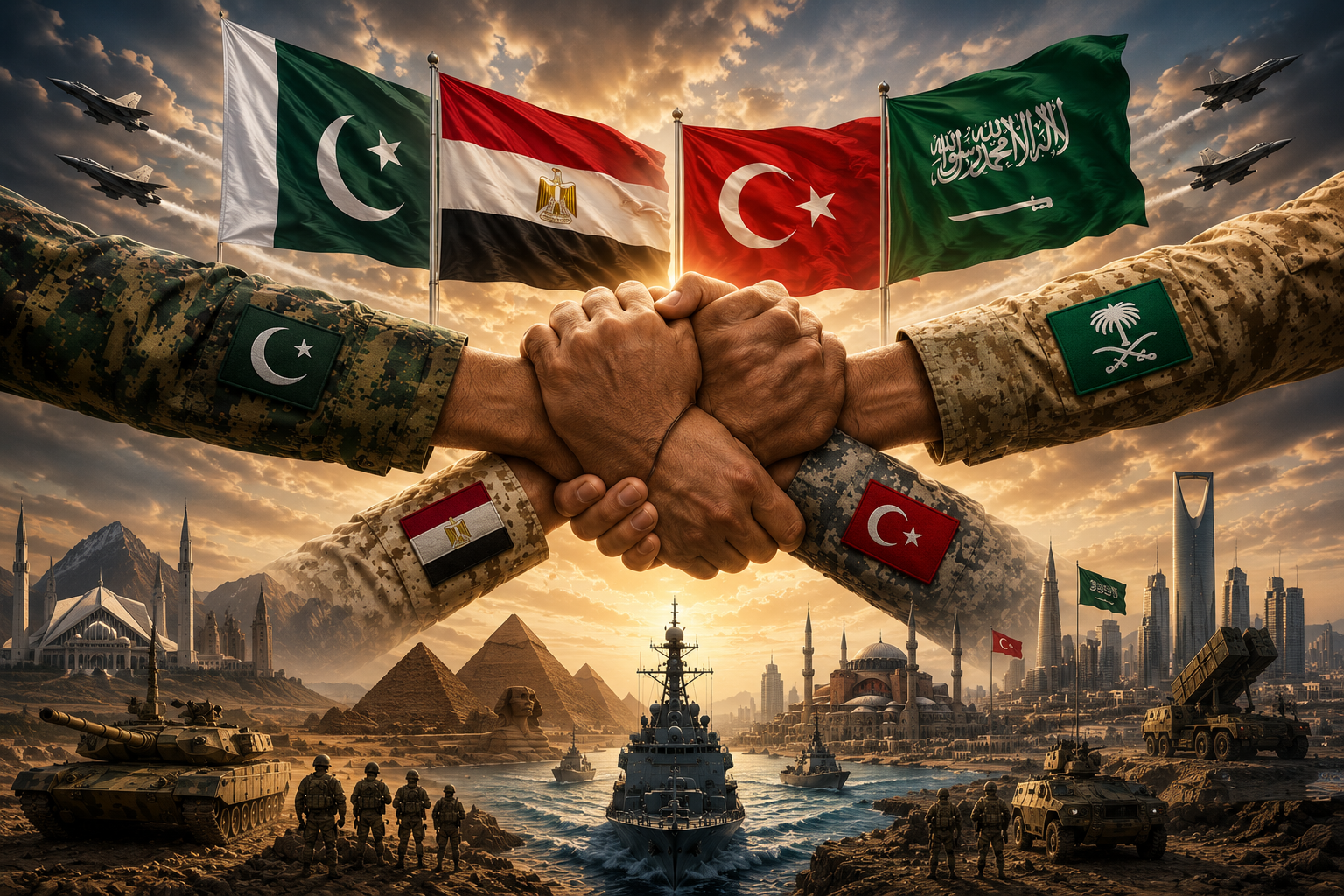
In an era of shifting global power balances, great-power retrenchment, and persistent regional volatility from the fallout of the US-Israel-Iran conflicts to concerns over Israeli assertiveness and Iranian influence four major Muslim-majority powers are quietly architecting a new security framework. Saudi Arabia, Turkey, Egypt, and Pakistan, often referred to as the “R-4” or a Middle Eastern quadrilateral, are moving beyond traditional bilateral ties toward deeper coordination. This is not yet a formal NATO-style alliance with collective defense guarantees, but a pragmatic, multi-layered security paradigm blending military pacts, defense-industrial collaboration, diplomatic mediation, and shared strategic interests.
Drivers of the New Paradigm
The encouragement sprouts from a shared perception of US “abandonment” or unreliability in key crises (e.g., limited responses to attacks on Gulf targets or regional escalations), alongside the need to counterbalance Iran and manage post-conflict stability. Historical rivalries such as Turkey-Egypt tensions or Saudi-Turkey competition have given way to pragmatic convergence among common threats.
Saudi Arabia brings financial clout, energy dominance, and a desire for diversified security beyond exclusive Western reliance. Riyadh’s Vision 2030 emphasizes indigenous capabilities and strategic autonomy.
Turkey contributes advanced defense technology (drones, missiles, naval systems), NATO membership experience, and assertive regional projection.
Egypt offers the Arab world’s largest conventional military force, strategic geography controlling key chokepoints like the Suez Canal, and deep experience in counter-insurgency and Sinai security.
Pakistan adds nuclear deterrence, a battle-hardened army, and longstanding military training/export expertise.
This combination creates a potent mix: Saudi funding + Turkish innovation + Egyptian manpower + Pakistani strategic depth.
Milestones in the Emerging Framework
The foundation was laid with the Saudi-Pakistan Strategic Mutual Defense Agreement (SMDA) signed in September 2025. This bilateral pact treats aggression against one as against both, formalizing decades of cooperation including Pakistani trainers in the Kingdom and potential nuclear umbrella considerations.
Subsequent developments accelerated in early 2026:
Foreign ministers’ meetings in Riyadh (March 19), Islamabad (late March), and Antalya (April), focusing on Iran-related de-escalation, Gulf security, and broader defense ties. Turkey’s push to join or parallel the Saudi-Pakistan pact, with discussions on trilateral and quadrilateral defense-industrial cooperation (joint exercises, arms production, technology transfer).
Egypt’s integration through bilateral military agreements with Turkey and expanded ties with Saudi Arabia and Pakistan, including support in regional theaters like Sudan and the Horn of Africa. The framework emphasizes practical pillars rather than rigid treaty obligations.
Defense Industrial and Procurement Synergies:
Joint ventures in drones, missiles, armor, and naval assets. Pakistan’s JF-17 program and Turkish Bayraktar drones could scale with Saudi investment and Egyptian demand.
Intelligence Sharing and Counter-Terrorism:
Coordinated responses to non-state threats and Iranian proxies.
Diplomatic and Mediation Role:
The quartet has positioned itself as a channel for US-Iran talks and advocates for Palestinian statehood, enhancing soft power.
Extended Theater Cooperation:
Engagements in Somalia, Sudan, and beyond to secure sea lanes and counter external influences.
Economic-Security Nexus:
Energy deals, infrastructure, and trade as stabilizers. Design Elements of the New Security Paradigm Unlike Cold War blocs, this paradigm is likely to remain flexible, a “concert of powers” or consultative mechanism with ad-hoc military components. Potential structures include.
A standing “Four-Capitals Council” or senior officials track for regular coordination. Shared early-warning systems, joint training centers, and interoperability standards.
Hybrid deterrence:
Conventional forces backed by Pakistan’s nuclear shadow and Turkey’s asymmetric capabilities.
Hedging:
Members maintain US, Chinese, or other ties while building autonomous capacity.
Challenges persist:
Differing threat perceptions (e.g., Turkey’s focus on Kurds vs. Saudi concerns over Iran), economic asymmetries, and external pressures from the US, Israel, or Gulf rivals like the UAE. Full institutionalization could take years, and contradictions (e.g., past rivalries) may resurface.
Strategic Implications
This quadrilateral could redraw the Middle East-South Asia security map, offering a Sunni-led alternative to fragmented orders dominated by Iran or external powers. It enhances collective resilience, boosts defense self-sufficiency, and amplifies influence in global forums like the OIC. For Pakistan, it elevates its role as a pivotal connector; for Saudi Arabia, it diversifies away from oil-centric vulnerabilities.
In a multipolar world, this new paradigm signals the rise of regional agency. Whether it evolves into a more binding alliance or remains a loose coordination platform will depend on sustained political will and crisis management success. What is clear is that Saudi Arabia, Turkey, Egypt, and Pakistan are no longer content to be passive players, they are actively designing a security architecture suited to 21st-century realities.