

By Dr Majid Khan (Melbourne):
On 7 August 2026, the leaders of Saudi Arabia, Turkey and Pakistan stood together in Islam’s holiest city and signed a collective defense agreement that has reshaped the strategic landscape of the Middle East in less than a week. Israel went silent. Iran went into contradiction. And two nuclear shadows one declared, one long suspected fell across the same document for the first time.
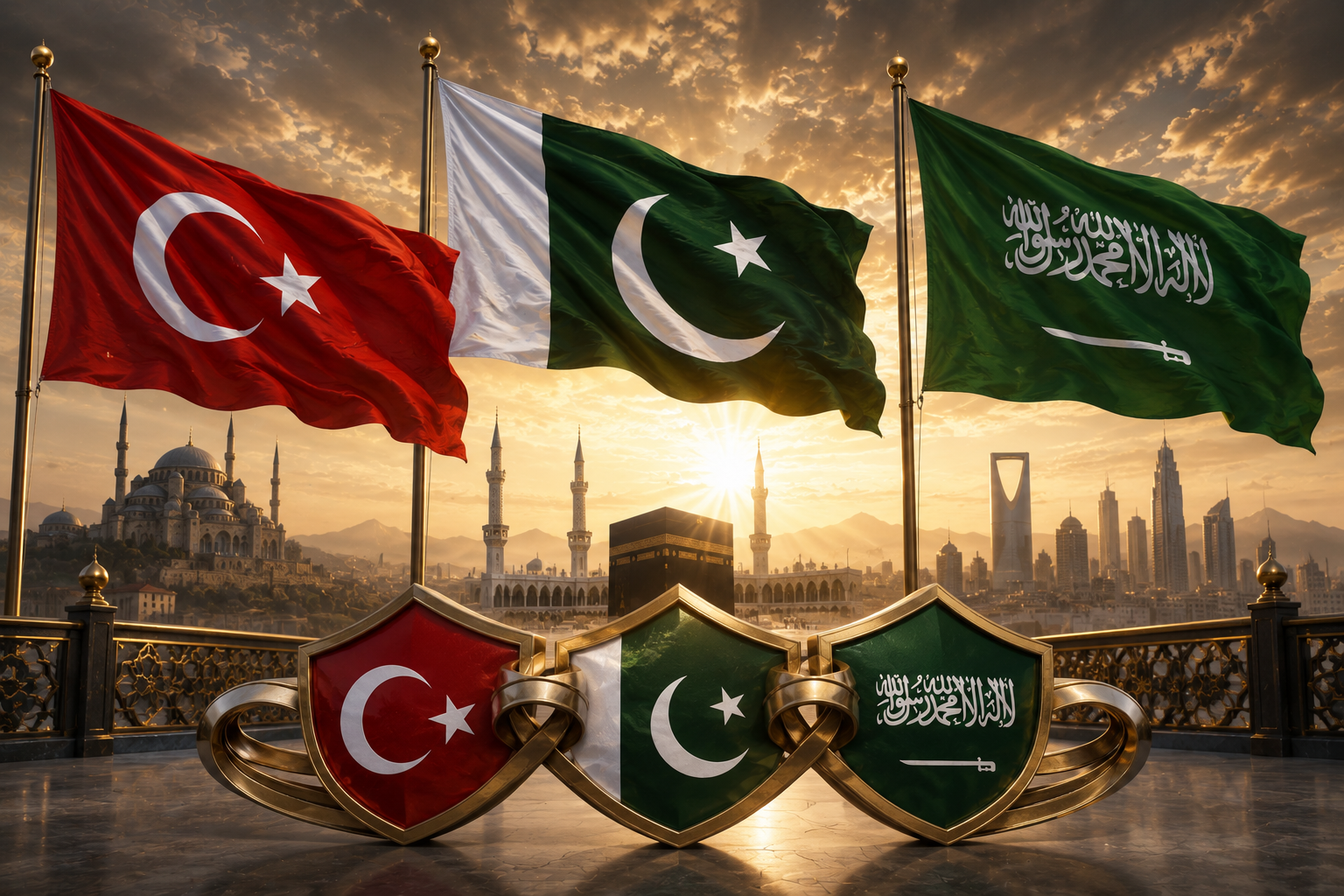
The setting was chosen with the precision of political theatre. Al-Safa Palace, in the city of Mecca Islam’s holiest site, the direction of every Muslim prayer, the destination of the annual Hajj was where, on the morning of Friday 7 August 2026, Crown Prince Mohammed bin Salman of Saudi Arabia, President Recep Tayyip Erdogan of Turkey, and Prime Minister Shehbaz Sharif of Pakistan sat down and signed their names to the Mecca Joint defense Agreement. The day was the Friday congregational prayer. The date was recorded in the official Pakistani foreign ministry press release in the Islamic calendar: 24 Safar 1448. The choice of Mecca was not incidental. It was a message wrapped in the symbolism of Islamic solidarity and delivered to every audience simultaneously.
The agreement itself follows the logic of NATO’s Article 5: an armed attack against any one of the three states shall be regarded as an attack against all three. It provides for enhanced defense cooperation, joint military exercises, intelligence sharing, defense -industrial collaboration, and interoperability among the three states’ armed forces. It builds on the bilateral Strategic Mutual defense Agreement between Saudi Arabia and Pakistan concluded in September 2025, and extends a comparable collective commitment to include Turkey’s NATO-integrated military machine and its formidable defense -industrial base most visibly Baykar’s drone ecosystem and the KAAN fifth-generation fighter programme.
The three signatories bring what analysts have consistently described as complementary strengths. Saudi Arabia contributes capital, geographic position, political weight in the Arab world, and a defense market that has absorbed more than $177 billion in military expenditure in its most recent fiscal year. Turkey contributes the second-largest standing army in NATO, advanced drone systems that have reshaped modern warfare from Nagorno-Karabakh to Ukraine to Libya, and a defense -industrial base that is actively expanding into missiles, naval platforms and electronic systems. Pakistan contributes a large and battle-experienced military and the single most significant strategic fact in the entire agreement an arsenal of approximately 300 nuclear warheads, making it the only Muslim-majority state with a nuclear deterrent.
The agreement was signed against the specific backdrop of the 2026 Iran war. Since late February, the United States and Israel have been engaged in direct military confrontation with Iran under Operation Epic Fury and Operation Rising Lion. Saudi Arabia has itself faced escalating Houthi drone and missile attacks, including a strike on Saudi forces at a base in eastern Yemen on the very day the pact was signed. The Houthis backed by Iran had earlier announced a blockade on Saudi Arabia. For Riyadh, the accumulation of threats had produced a single, overriding strategic conclusion: the United States, consumed by the Iran war and plagued by internal debates about overextension, could no longer be relied upon as the sole guarantor of Gulf security. The Mecca pact is, among other things, Saudi Arabia’s answer to that conclusion.
The joint statement issued after the signing is notable as much for what it omits as for what it includes. The agreement never names Iran. It never names Israel. It does not specify what military action any signatory would actually take if a partner were attacked, leaving the obligations deliberately unspecified an ambiguity that is itself a form of strategic communication. Ankara’s official position is that the pact is “purely defensive” and “directed at no specific actor,” with a Turkish official adding that it remains open to other regional countries.
Israel’s official response to the Mecca pact was, in the first instance, no response at all. As Al Jazeera reported, Israel had not officially acknowledged the agreement in the days following its signing a silence that was itself loudly communicative. The pact brought together three countries, each of which has complicated and largely hostile relationships with Israel: Turkey, whose President Erdogan has been among the most consistently vocal critics of Israeli military policy, including during and after the Gaza war; Saudi Arabia, which Israel has spent years courting toward the Abraham Accords framework, and whose normalisation with Jerusalem has been a centrepiece of U.S. regional strategy; and Pakistan, which does not recognise Israel and has never maintained diplomatic relations with it.
The Jerusalem Post framed the pact through the lens of its implications for Israeli security architecture, noting that the agreement had effectively complicated perhaps fatally the already difficult path toward Saudi-Israeli normalisation. By binding itself more closely to Ankara and Islamabad, two capitals fiercely hostile to Tel Aviv, Riyadh had entered a strategic framework whose other members would strongly oppose any Saudi move toward the Abraham Accords. The Post noted the central irony: some analysts had assumed that the weakening of Iran would naturally strengthen Israel’s ties with pragmatic Arab states. Instead, Iran’s weakening and Israel’s demonstration of its own military reach appeared to have led some of those states to fear Israeli dominance, and the Mecca pact was one way to counter it. The paper also noted that Prime Ministers Netanyahu and Modi had spoken by telephone in the hours after the signing, with Modi alluding to ‘progress on various aspects of the India-Israel Special Strategic Partnership’ a signal that Tel Aviv and New Delhi were already discussing the pact’s implications for their own bilateral security relationship.
Emirati researcher and foreign policy expert Huda Albadi, writing in the Jerusalem Post, described the pact as a “paper tiger” whose practical military effect remained limited. But she also warned of the broader mentality it represented: a regional framing in which Israel, rather than Iran, is cast as the primary destabilizing power. “They are looking at Israel as if it is the enemy,” she said. That framing emerging not from Tehran but from Riyadh, Ankara and Islamabad is, for Israel, more strategically threatening than the treaty’s specific military provisions.
Iran’s reaction to the Mecca pact has been a study in carefully managed contradiction. At the official level, Tehran has played it down. Iran’s foreign ministry spokesperson, Esmaeil Baghaei, said at a press conference on Monday that Tehran saw “no reason to be concerned” that the new pact was directed against Iran. He offered an interpretation that was almost audacious in its confidence: the pact, he said, showed a “change in perception” toward the United States and a shift in the regional approach to security. Countries in the region had “realized that the greatest threat to the region and the world is Israel” and that they could no longer rely on U.S. assurances of protection.
Iran International, the Persian-language broadcaster that provides extensive coverage of Iranian affairs from an opposition perspective, reported the pact’s Iranian reaction in granular detail and the picture it painted was more anxious than the official line admitted. Iranian parliamentary members and clerics moved quickly to mock the agreement in terms that revealed the depth of their discomfort. Ebrahim Rezaei, a member of the Iranian parliament’s national security committee, wrote on X: ‘The Saudis should know that a paper agreement with Turkey and Pakistan will not bring them security, just as years of one-way nursing of the Americans brought them none. Correct your policies so you no longer need to go begging for security.’ The Qom Friday prayer leader, Alireza Arafi, was blunter still: ‘Borrowed security and begging America for security will not save you,’ he told congregants, promising that ‘the roar of our missiles’ would reach the pact’s signatories. The pact’s statement had avoided Iran’s name. Tehran’s clerical establishment named it for them within hours.
Iranian Foreign Minister Araghchi’s reaction was more oblique. On the day of the signing, he called for Muslims around the world to show unity, writing: “When Muslims stand together, we can face every challenge by malicious outsiders head-on.” He added: “Time to rely only on ourselves and embrace true brotherhood.” It was not immediately clear whether his remarks were a direct response to the pact or a broader appeal but the timing was not accidental. Iran was positioning itself not as the pact’s target but as the spiritual precedent for the unity it embodied.
The Jerusalem Post, drawing on expert analysis, offered a more unsettling reading of Tehran’s real position. The Mecca pact, one analyst suggested, would be viewed by Tehran as a major success resulting from its aerial attacks on Gulf states evidence that Iranian military pressure had succeeded in compelling Saudi Arabia to formally distance itself from the U.S. security umbrella and seek alternative arrangements. That reading inverts the pact’s deterrence logic entirely: rather than restraining Iran, it could reinforce Tehran’s conviction that military pressure produces strategic results.
The single most consequential element of the Mecca agreement the one that neither the signatories nor their critics have directly addressed is Pakistan’s nuclear arsenal. Pakistan is the only Muslim-majority state with nuclear weapons. Its estimated 300 warheads represent a strategic capability that no other signatory to the pact, and no other regional power outside Israel, possesses. Speculation about a Pakistani nuclear guarantee for Saudi Arabia is not new. For decades, analysts have discussed the possibility that Pakistan whose nuclear programme was substantially funded by Saudi money in the 1970s and 1980s might offer Riyadh some form of nuclear deterrence in an extreme scenario. The Mecca pact does not formalize such an arrangement. It almost certainly does not need to. The presence of Pakistan’s nuclear deterrent within a collective defense framework sends a signal without requiring explicit language. Any adversary calculating the risks of a major attack on Saudi Arabia must now factor in the Pakistani military’s capabilities and the ambiguity of what the agreement’s collective defense clause might ultimately entail.
For Israel, this is the sharpest edge of the pact. Israel has long been assumed to be the Middle East’s sole nuclear-armed state. The Mecca agreement places a state with 300 nuclear warheads inside a collective defense arrangement with two of Israel’s most adversarial regional neighbours. The pact does not create a nuclear alliance. But it creates a strategic environment in which the nuclear question previously an Israeli monopoly has become considerably more complicated.
The region has, as Al Jazeera noted, never lacked agreements. It has lacked shared political foundations. The Arab coalition in Yemen, established in 2015, eventually faltered as divergent national interests clashed with the logic of collective action. The Mecca pact faces the same test: Saudi Arabia sees in it a counterweight to Iran. Turkey sees it as deterrence against Israeli expansionism and an affirmation of its strategic weight beyond NATO’s eastern flank. Pakistan sees it as enhanced security against India and a dramatic elevation of its international standing. These are not identical interests. Whether they are compatible enough to sustain a functioning alliance under fire, under pressure, under the inevitable tensions of states with their own foreign policy constraints is the question the pact’s signing ceremony did not answer.
What the ceremony in Mecca did answer or at least address was a different question: who speaks for Muslim security in a region being reshaped by war? The answer written into that document, in that city, on that Friday, was not Washington. It was not Tehran. It was three governments who walked into Al-Safa Palace as regional powers and walked out as something that, if it holds, could become considerably more.


