


ASTANA — Amid rising inflation and mounting climate pressures, Kazakhstan faces a critical intersection between water management and food security. Experts and government officials convened in an online conference on January 29 to examine how dwindling water availability—and potential shortfalls—threaten irrigated agriculture, livestock production, and overall domestic food stability.
With annual inflation reaching 12.3% in 2025, participants stressed that improving water efficiency is essential not only for sustaining crop and livestock output but also for curbing food price surges that exacerbate economic strain on households.
Water scarcity has evolved far beyond a sectoral agricultural concern. It now represents a multifaceted economic, social, and geopolitical risk. Intensifying competition over transboundary rivers, escalating demand, and inadequate governance could heighten vulnerabilities in key farming areas and urban centers alike.
The Root Causes of Kazakhstan’s Water Deficit
 Rahimbek Abdrakhmanov, head of the Center for Political-Economic Analysis, urged treating water deficit as a top-tier national risk with far-reaching repercussions.
Drawing on Eurasian Development Bank figures, he highlighted alarming inefficiencies: water losses during transport and in agriculture range from 40-50%, resulting in massive volumes never reaching productive use. Regional studies, he added, show a marked rise in tensions tied to transboundary rivers over the past decade.
“From 2014 to 2024, the number of conflicts in Central Asia linked specifically to water use, transboundary rivers and related issues increased significantly,” Abdrakhmanov said. “The risk of water deficit is one of the most important risks for Central Asian countries, and it can trigger cascading problems, including food security, migration and others. A third of Central Asia’s population does not have access to clean drinking water.”
Climate Change, Transboundary Rivers, and Geographic Imbalances
Marat Imanaliyev, deputy director of the water policy department at the Ministry of Water Resources and Irrigation, described declining river inflows and stark regional disparities in water distribution. Eastern and southeastern areas depend more on local surface sources, while southern, western, and central regions experience acute shortages relative to population density and economic demands.
Seasonal mismatches have grown sharper, he noted. “When water is needed, during the vegetation period, it is not there, but it is there when it is not needed,” Imanaliyev explained, attributing the shift to altered precipitation patterns driven by climate trends.
On international coordination, Kazakhstan maintains water-sharing agreements with Russia, Kyrgyzstan, and Uzbekistan, while ongoing talks continue with China concerning shared rivers such as the Ili, which feeds into Lake Balkhash.
Agriculture and Livestock Bear the Brunt
 Agriculture dominates water consumption, with roughly 90% of withdrawals directed to irrigation—much of it non-recoverable, according to Imanaliyev.
Bulat Yessekin, an international expert and coordinator of the Central Asian platform on water management and climate change, warned that accelerating water decline directly jeopardizes long-term food planning. He cited southern irrigation demands as illustrative: this year alone, the region consumed 11 billion cubic meters for crops.
As shortages intensify, agriculture will absorb the initial impact, with ripple effects on food prices, rural employment, and export strategies.
Arsen Islamov, a livestock specialist, called for pragmatic crop adaptation discussions. He suggested transitioning from water-intensive rice to alternatives like alfalfa, which could bolster feed supplies, curb soil erosion, and better align with regional realities. Yet he cautioned against overlooking rice’s role in local economies and questioned the relative contributions of glacial melt versus seasonal rains to river flows.
Islamov emphasized Kazakhstan’s identity as a “wheat civilization,” not rice-based. The northern grain belt—encompassing Kostanai, Akmola, and North Kazakhstan regions—underpins staple food security not just domestically but across Central Asia, where flour-based foods predominate.
Disrupted “Green Water” and the Global Water Cycle
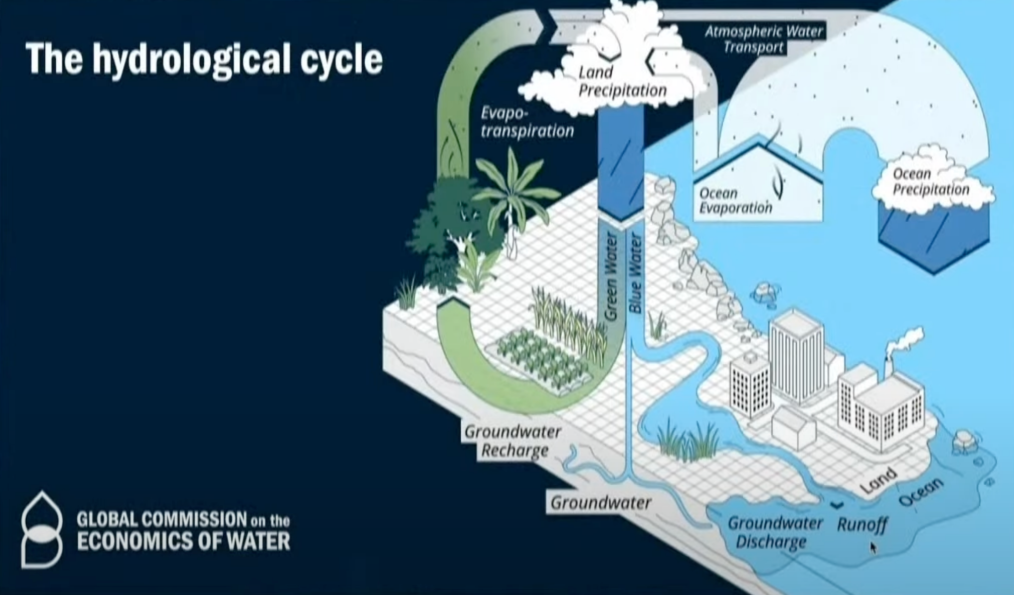
Yessekin broadened the discussion beyond surface shortages to fundamental disruptions in the hydrological cycle, particularly “green water”—moisture held in soils, plants, and the atmosphere.
Referencing the 2024 One Water Summit (co-initiated by France and Kazakhstan), he noted warnings that humanity has, for the first time, altered global water flows—even as the planet’s total water volume remains largely constant.
“The key cause of the crisis is the disruption of hydrological cycles, the disruption of green water flows,” Yessekin said. “We assumed nature would keep replenishing it. Nature has stopped doing that. That is why current management models are no longer sufficient.”
He criticized prevailing approaches that treat water mainly as an economic commodity rather than a pillar of biodiversity, climate stability, and sustained availability. While over 18 international bodies address water fragments, no unified framework prioritizes cycle restoration.
Yessekin advocated basin-level governance to integrate sectors, dismantle silos, and enable cross-border coordination. He lamented that, despite over 500 proposals incorporated into Kazakhstan’s Water Code, empowering basin councils with real authority—as practiced in France and Canada—remains pending and urgent.
Proven Efficiency Gains and Calls for Gradual Change
Kuralai Yakhyayeva of the Kazakh branch of the Scientific Information Center on Water Management shared successes from a long-running pilot in the lower Syr-Darya basin (Kyzylorda Region), a key rice area.
Launched in 2013, the project introduced precise measurement, rigorous accounting, and laser land leveling. Water application dropped from over 31,000 cubic meters per hectare to 22.5 in the pilot zone—a 28% saving—without yield losses.
She also highlighted hydromodule-based recalculations to optimize allocations across agriculture, municipalities, and industry.
Sagidulla Syzdykov, representing the Rice Producers and Processors Association and GP Abzal&Company, acknowledged rice’s high water intensity but argued that outdated figures overlook recent irrigation advances. He stressed the climatic and economic constraints on rapid crop shifts in Kyzylorda, where rice sustains rural livelihoods. The region has felt deficits for eight years, exacerbated by upstream developments in neighboring states and climate change.
Toward Integrated Water Governance as Food Policy
Imanaliyev outlined ministry efforts to craft basin plans and forecasting tools for smarter allocations. He cautioned that sudden curbs without farmer alternatives risk social tension, noting that low-water decisions increasingly involve basin councils.
Yessekin insisted efficiency alone falls short without ecosystem restoration. “If we only do water saving, it means we are spending our bank account more carefully without replenishing it,” he said. “We need to stop wasting water and start restoring water flows through restoring land, forests, vegetation and catchment areas.”
As Kazakhstan navigates these intertwined crises, the conference underscored a clear message: effective water policy is no longer optional—it is central to safeguarding food security, economic stability, and regional resilience in an era of accelerating change.
Note: The provided text is an article from The Astana Times (published February 3, 2026), based on an online conference held on January 29, 2026. Here’s a rewritten version structured as a full, cohesive news article in a journalistic style, with clear sections, smooth transitions, and an engaging narrative flow while preserving all key facts, quotes, and details.