

Democracy does not live only in constitutions, elections and courts. It also lives in the places where people meet, wait, argue, rest, organise and remain without permission. When those spaces become harder to shape, harder to inhabit, or harder to use without paying, democracy weakens long before anyone announces its decline.
Much of the debate about democratic erosion focuses on leaders, institutions and laws. These are essential arenas. But there is another, less examined terrain: the built environment.
In many contemporary democracies, citizens formally retain political rights, even the vote, while gradually losing practical influence over the spaces in which collective life unfolds. This change rarely arrives as a coup. It arrives through administration.
Over recent decades, urban governance has grown steadily more complex. Zoning systems, insurance requirements, fire regulations, procurement rules and liability frameworks now heavily determine what is possible and who is allowed to attempt it. Each can be justified on its own terms. Yet together they produce a familiar result: meaningful spatial agency shifts away from ordinary citizens and toward institutions able to absorb complexity, risk and delay.
The outcome is not outright repression. It is dependence.
That matters because the built environment is one of democracy’s main settings. Most of our lives are spent indoors: in homes, schools, workplaces, transport systems, waiting rooms, shops and public buildings. Cities are not passive containers of democracy. They organise its habits. They influence whether people linger or hurry, gather or disperse, speak or remain isolated.
The weakening of public space makes this especially visible. A democracy needs places where people can remain without having to justify themselves through consumption. Yet many of the spaces where people once gathered informally, squares, sidewalks, kiosks, benches, shaded corners, small local shops, are being reduced, privatised, or redesigned to keep people moving. Even where public life remains active, it is increasingly displaced into malls, cafés and other privately controlled interiors, where gathering is tolerated only under the owner’s rules. If the owner tells people to leave, most people shrug: it is their space. But if people are dispersed from a truly public square, that becomes news. That difference goes to the heart of who has the right to appear, linger and speak.
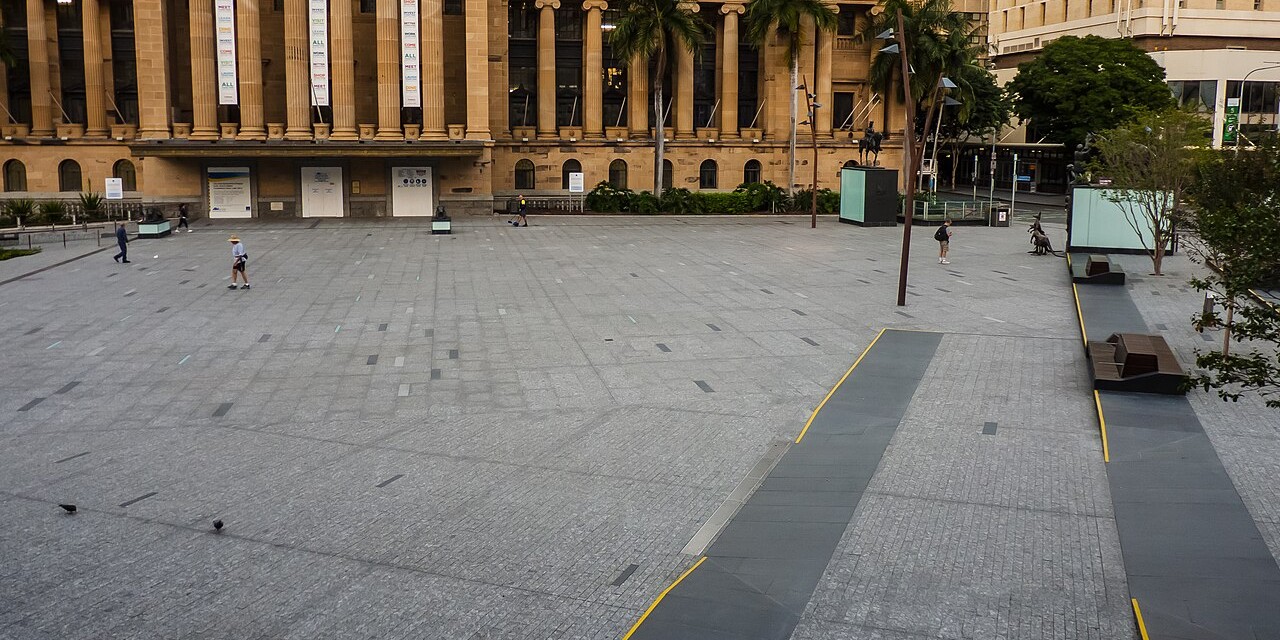
Sometimes the erosion is absurdly mundane. A bench not installed. A tree not planted. A kiosk removed. A square redesigned for circulation rather than encounter. Yet these details are not minor. They determine whether a city invites public life or merely manages foot traffic. Stand in a hard, exposed square such as King George Square in Brisbane and the point becomes literal. The question is not whether the square is attractive, but whether it allows people to gather in comfort without needing a commercial reason to be there.
Community-led building initiatives reveal a similar pattern. Groups that want to convert abandoned public buildings into housing, shared workspaces or civic uses often find themselves blocked by regulatory thresholds designed for larger, capital-backed actors. Cooperative and small-scale housing initiatives encounter systems calibrated for developers with legal, technical and financial infrastructure behind them. Renovation and adaptive reuse are treated as burdensome exceptions, while demolition proceeds more easily as the default option.
Participation then survives more as ritual than as power. Citizens may be consulted, invited to workshops, or asked for feedback. Yet the decisive parameters, compliance, financing, liability and administrative interpretation, usually remain beyond their reach. Democracy continues procedurally, but it thins materially.
I have seen versions of this in my own work with Gamified Cohousing in Finland. Attempts to reactivate underused buildings for affordable, community-oriented living have sometimes been undermined not only by regulation, but by the murkier traffic between administrative opacity and public narrative. In one case in Lappeenranta, a national news article appeared only hours before a municipal body was due to deliberate on the project. From the project’s point of view, the sequence looked less like neutral reporting than like an intervention in the atmosphere of decision-making itself. Afterwards, the city official involved and the broadcaster denied improper coordination. But for a small civic enterprise, that is almost beside the point. Reputational damage, tenant loss and financial stress can arrive in a single day; complaint procedures take years. One of the more elegant hypocrisies of our time is that the procedures remain while the damage is done elsewhere, earlier, and with no effective remedy.
This pattern has a broader political parallel. Contemporary authoritarianism often preserves democratic forms while narrowing democratic substance. Elections continue, institutions remain in place, legality is maintained, yet power becomes more centralised through administrative and legal instruments. A similar tension can be seen in spatial governance. Cities increasingly speak the language of participation, inclusion and community, while the actual authorship of space is concentrated in fewer hands.
Projects such as NEOM’s THE LINE in Saudi Arabia make the logic easier to see because they strip away the democratic decorum. It is promoted as a 170-kilometre car-free linear city: hyper-efficient, AI-enabled, vertically organised, and designed so that daily life is reduced to a managed sequence of optimised access. It is architecture marketed as destiny. Technology supplies the legitimacy; scale stands in for consent. Such projects are clarifying because they show what happens when scrutiny, dissent and public recourse are treated as irritants rather than democratic necessities.
None of this requires bad intentions. It grows from a familiar modern logic: optimisation, risk minimisation and technical control. Advanced societies tend to over-engineer their systems. They create frameworks so elaborate that only specialists can navigate them with confidence. Standards become so dense that only well-capitalised actors can fully comply. Complexity then functions not only as protection, but also as exclusion.
When this happens, housing is more easily treated as an asset than as a social good. Public buildings are assessed primarily through compliance cost rather than civic potential. Shared spaces are judged by liability exposure before they are valued as settings for common life. The citizen’s role changes subtly but significantly: from co-producer to end user.
This is not an argument against safety, expertise or regulation. It is an argument for examining their cumulative effects. If democratic renewal is to be taken seriously, it must reach beyond elections and institutional safeguards. It must also ask whether the structures governing land, housing and public buildings still allow citizens to act meaningfully within them. In practical terms, that means earlier participation in planning, not merely consultation after decisions are framed; clearer public access to budgets, procurement logic and design rationales; easier adaptive reuse for civic and community-led projects; and defending places where people can gather without having to buy their right to remain there.
A democracy in which citizens retain the vote but lose practical capacity to co-design, co-build and co-govern shared environments is not abolished. But it is diminished.
Attention to democratic decline should therefore not stop at parliaments and presidencies. It should also turn toward planning departments, building codes, housing systems, public squares, unchecked public narratives that shape local development conflicts, and the slow privatisation of shared space. Democracy does not weaken only when constitutions fail. It also weakens when citizens cease to experience themselves as authors of their collective world.
And that experience is, in part, architectural.
Source:https://toda.org/global-outlooks/democracy-and-the-spaces-we-can-no-longer-shape/