

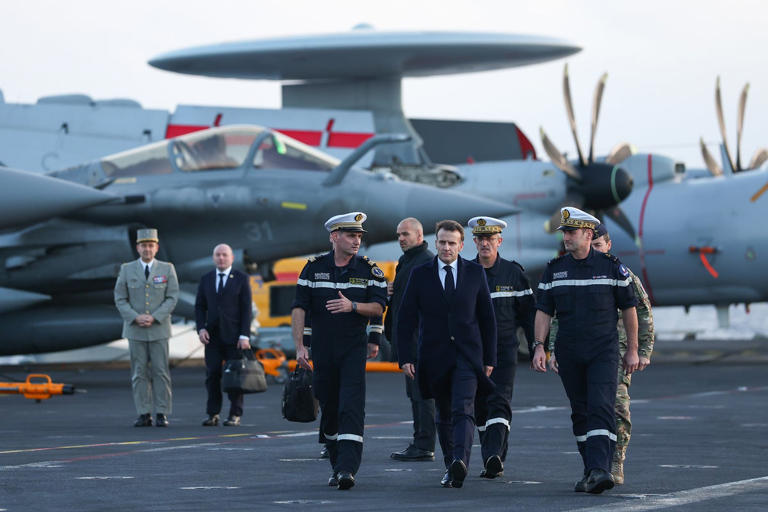
PARIS — France’s flagship aircraft carrier strike group has begun moving south of the Suez Canal into the Red Sea as part of preparations for a potential joint French-British mission to secure the Strait of Hormuz, French armed forces officials said Wednesday.
The redeployment places the nuclear-powered carrier Charles de Gaulle — Europe’s most powerful warship — within operational reach of one of the world’s most sensitive maritime chokepoints, where tensions linked to the ongoing Iran conflict have severely disrupted global shipping and energy markets.
The strike group and its escort fleet were repositioned following a March 3 announcement by President Emmanuel Macron, made one day before Tehran closed the strait. The waterway normally handles nearly one-fifth of the world’s oil shipments. The International Energy Agency has described the current disruption as potentially the largest supply shock in oil market history.
“Going south of Suez is new for us,” Col. Guillaume Vernet, spokesperson for the French armed forces chief of staff, told The Associated Press. “Geographically, it’s closer to the Strait of Hormuz and will therefore enable us to react faster, once the conditions are met.”
Vernet said operational planning for a multinational mission had been completed. “Planning has been done and is ready to go,” he said.
Conditional deployment
French officials stressed that any deployment into the strait remains conditional. Two key thresholds must be met, they said: a reduction in threats to commercial shipping and sufficient confidence among maritime operators to resume transit.
“Today the Strait of Hormuz is stuck because of the threat, and the insurance premiums are so high,” Vernet said. “Not a single ship will jeopardize their trip or go there.”
Industry estimates indicate war-risk insurance premiums for vessels transiting the strait have risen to four or five times pre-conflict levels, and roughly 2,000 ships remain stranded in Gulf waters. Officials added that any operation would require approval from regional states bordering the Gulf.
Separate from U.S. effort
The French-led initiative remains distinct from the U.S.-backed “Project Freedom” mission, which was launched Sunday and later paused Tuesday evening by President Donald Trump. Washington has not participated in the Franco-British planning effort.
Unlike the American operation, France insists its proposed coalition would maintain a strictly defensive mandate under international law.
“The French position is the same since the beginning — defensive posture, respecting international law,” Vernet said.
French officials trace the initiative to early March, after Iran shut the strait in retaliation for joint U.S. and Israeli strikes that began Feb. 28. Those strikes reportedly killed Iranian Supreme Leader Ayatollah Ali Khamenei.
Vernet said France immediately pushed for a multinational effort to restore freedom of navigation. “Right after that, we had the opportunity to build things with different countries,” he said, citing Britain, Italy, the Netherlands and several other partners.
Broader deployments
Macron and British Prime Minister Keir Starmer hosted representatives from dozens of countries during a Paris summit on April 17. Military planners from more than 30 nations finalized operational details at Britain’s Permanent Joint Headquarters in Northwood on April 22-23.
The Charles de Gaulle strike group was originally redeployed from the Baltic Sea to the eastern Mediterranean following Macron’s March 3 address in what the presidency called an “unprecedented” regional mobilization. The broader deployment includes eight frigates and two Mistral-class amphibious assault ships.
French Rafale fighter jets operating from Al Dhafra Air Base in the United Arab Emirates have been intercepting Iranian drones and missiles over the Gulf under a longstanding defense agreement with Abu Dhabi.
The carrier group’s southward movement now places French air assets — including 20 Rafale fighters and E-2C Hawkeye surveillance aircraft — within operational range of the strait without directly entering Gulf waters, where the U.S. Navy has maintained a blockade of Iranian ports since April 13.
Vernet declined to provide a timeline for any French-British operation, saying the strike group was being positioned to respond rapidly “if and when the conditions are met.”