

By Dr Majid Khan (Melbourne):
After months of escalating confrontation that pushed the United States and Iran to the edge of a wider regional war, a surprise diplomatic breakthrough has shifted the geopolitical landscape. A formally brokered peace agreement, announced after intensive negotiations involving regional intermediaries and European diplomatic channels, has paused direct military hostilities between Washington and Tehran for the first time in a prolonged period of instability.
The agreement, while welcomed across much of the international community, has not erased the structural tensions that led to conflict in the first place. Instead, it has exposed a deeper reality of modern geopolitics: even when wars end, the economic systems built around them do not simply disappear. They adapt.
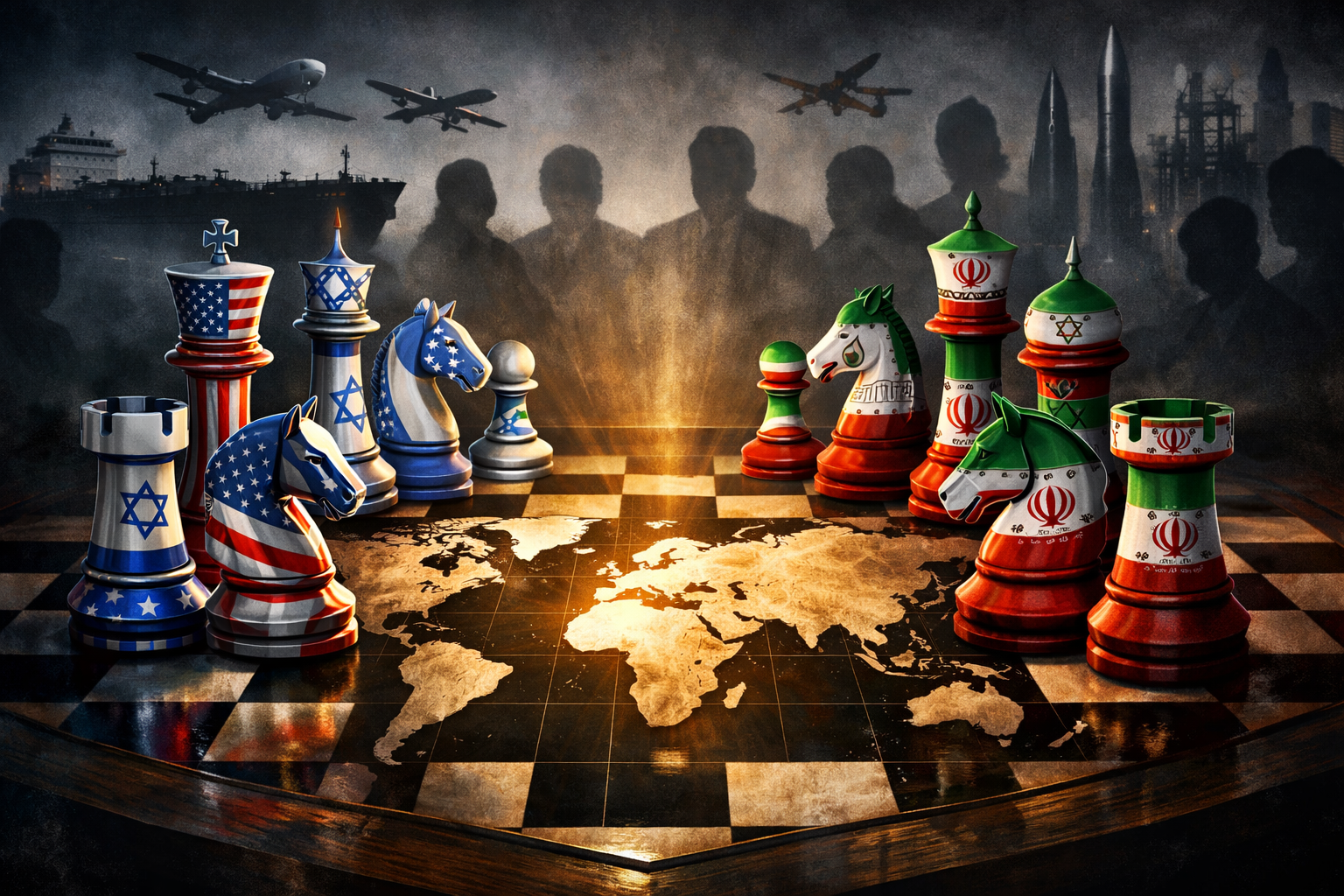
The ceasefire between the United States and Iran marks a turning point in a confrontation that had already reshaped energy markets, disrupted maritime security in the Persian Gulf, and triggered a surge in global defense spending. Yet as diplomats celebrate the reduction in immediate violence, analysts are turning their attention to a more uncomfortable question: what happens to the global business of war when the war itself pauses?
In the weeks leading up to the agreement, tensions had escalated through a series of naval incidents, drone interceptions, and retaliatory strikes across key strategic corridors. Oil prices fluctuated sharply as traders priced in the risk of sustained disruption in the Strait of Hormuz, a critical chokepoint for global energy flows. Defense systems across the Gulf region remained on high alert, and military deployments increased as governments prepared for potential escalation.
Then, almost abruptly, negotiations gained traction. The breakthrough came through a combination of back-channel diplomacy and regional pressure, with multiple states seeking to avoid a wider conflict that threatened economic stability well beyond the Middle East.
The resulting peace deal includes commitments to de-escalation, phased military restraint, and renewed discussions on nuclear oversight and regional security frameworks. While fragile, it has already reduced immediate military activity and stabilized certain key shipping routes.
But even as the political narrative shifts toward peace, the economic consequences of the conflict remain deeply embedded in global systems.
The modern defense economy does not operate on short cycles of war and peace. Instead, it functions on long procurement timelines, multi-year contracts, and continuous modernization programs. Weapons systems built or deployed during conflict are rarely decommissioned once hostilities end. They are maintained, upgraded, and integrated into standing defense infrastructure.
This means that even after a peace agreement, the financial momentum generated by war continues.
During the U.S.-Iran confrontation, defense manufacturers across the United States, Europe, and allied countries experienced a surge in demand. Missile defense systems were deployed across multiple theaters. Naval assets were repositioned in the Gulf. Surveillance technologies were rapidly expanded. Each of these deployments generated contracts not only for equipment, but for maintenance, logistics, software updates, and long-term service agreements.
These contracts do not disappear with the signing of a peace deal. In many cases, they expand in complexity.
Governments that experienced direct exposure to conflict often respond by increasing their long-term defense readiness budgets. Even after hostilities cease, the perceived risk environment does not fully revert to pre-conflict levels. Instead, a new baseline of caution is established. Military planners assume that similar crises may recur, and procurement strategies are adjusted accordingly.
In this sense, peace does not reverse militarization. It recalibrates it.The United States remains central to this dynamic. As the world’s largest defense exporter, its military-industrial base is deeply integrated into global security arrangements. American defense companies supply aircraft, missile systems, intelligence platforms, and advanced naval technologies to allies across Europe, Asia, and the Middle East.
During the Iran conflict, these systems were deployed or positioned in anticipation of escalation. Now, under conditions of formal peace, those same systems remain active within broader deterrence frameworks.
For defense contractors, this transition represents a shift rather than a contraction. Wartime production peaks are replaced by sustained maintenance cycles and modernization programs. Governments that expanded inventories during conflict now focus on replenishment, upgrading, and integrating new technologies developed during the crisis period.
The economic logic of the defense industry ensures that demand remains resilient even in periods of reduced conflict intensity.
At the same time, the peace deal has altered global energy markets. The Strait of Hormuz, which had been at risk of partial disruption during the height of tensions, has reopened fully to commercial shipping. Oil prices have stabilized, though they remain sensitive to political developments in the region. Energy companies that had been hedging against prolonged instability are now recalibrating forecasts for global supply and demand.
However, the broader lesson for global markets is not simply that peace reduces risk. It is that volatility itself has become a structural feature of the international system.
In the years preceding the conflict, global defense spending had already been rising due to multiple overlapping crises, including the war in Ukraine, instability in Gaza, and growing competition among major powers. The U.S.-Iran confrontation added another layer to this pattern, reinforcing the perception that geopolitical risk is no longer episodic but continuous.
The peace agreement, while significant, does not reverse this trend. Instead, it adds a new chapter to an evolving cycle in which conflict and diplomacy coexist within the same strategic environment. Nations prepare for war even as they negotiate peace. Defense industries expand during crises and consolidate during calm periods. Investors treat both escalation and de-escalation as signals for market movement.
This interplay has raised persistent questions among analysts about the long-term relationship between conflict and profit.
Defense spending is often justified in terms of deterrence and national security. Governments argue that military preparedness prevents war rather than encourages it. Yet the economic systems surrounding defense procurement are undeniably structured around sustained demand, long-term contracts, and continuous technological development.
Even in peace, these systems remain active. The U.S.-Iran peace deal illustrates this tension clearly. While it has reduced immediate military risk, it has also solidified the role of defense infrastructure across the Middle East. Air defense systems remain deployed. Naval patrol routes remain active. Intelligence-sharing agreements continue. Military readiness has not been dismantled; it has been institutionalized.
This institutionalization ensures that defense spending remains a permanent feature of national budgets.
Critics of the global arms economy argue that this creates a paradox. Peace agreements reduce immediate violence but rarely reduce military expenditure in a proportional way. Instead, they often shift spending from active combat operations to long-term readiness, procurement, and modernization.
Supporters of defense investment argue that this is not a flaw but a necessity. In an unpredictable world, preparedness is considered essential. Military capability is maintained not because war is expected, but because uncertainty cannot be eliminated.
The result is a global system in which the boundary between war and peace is increasingly blurred.
The U.S.-Iran peace deal may mark the end of one chapter of direct confrontation, but it does not represent a departure from the broader geopolitical reality that has defined the past decade. Conflicts in Ukraine, Gaza, and other regions continue to shape defense planning, energy markets, and international alliances.
In this context, the business of war does not end with peace. It evolves. Contracts signed during conflict continue to generate revenue long after ceasefires are declared. Technologies developed for wartime use are integrated into peacetime defense systems. Military alliances forged under pressure become permanent strategic frameworks.
The machinery of global defense does not shut down when diplomacy succeeds. It adjusts, adapts, and continues operating within a world where uncertainty remains the dominant condition.
And so, while the peace deal between the United States and Iran may have closed a dangerous chapter in regional confrontation, it has also highlighted a broader truth about modern geopolitics: in the twenty-first century, the end of war rarely means the end of the systems built around it. Instead, those systems persist, shaping economies, policies, and industries long after the fighting stops.
The war may pause. The business of preparing for the next one does not.