

EDINBURGH – The Edinburgh Business School at Heriot-Watt University convened a webinar on 27May titled The Middle Corridor and the Future of UK-Central Asia Trade. Bringing
together voices from academia, business and the expert community, the discussion
explored whether the UK should look beyond the Middle East and pay closer attention
to partnerships in the South Caucasus, Central Asia and the wider Eurasian region –
areas that are becoming increasingly connected to Europe through an emerging
multimodal trade and energy network.
The closure of the Strait of Hormuz – through which roughly a fifth of the world’s
liquefied natural gas and seaborne oil passes – has again exposed the fragility of global
energy supply chains. With little clarity over how or when the confrontation between
the United States, Israel and Iran may subside, markets are bracing for prolonged
instability.
At the same time, the continued threat posed by the Houthis in Yemen raises risks to
the security of the Bab el-Mandeb Strait, the narrow maritime chokepoint linking the
Red Sea to the Gulf of Aden and the Indian Ocean, while broader instability in the Horn
of Africa, including Somalia, further compounds regional maritime security risks.
The consequences are already being felt in the UK. Energy executives have warned
that household bills could rise by as much as £209 from July as tensions in the Gulf
reverberate through global markets. Fuel prices have likewise climbed sharply, with
petrol rising by more than 25p per litre and diesel by nearly 50p nationwide since
hostilities intensified.
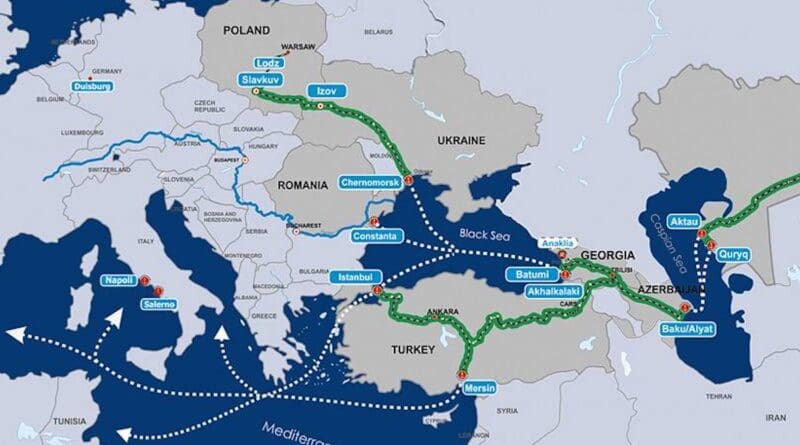
At the centre of that discussion lies the Middle Corridor, officially known as the TransCaspian International Transport Route (TITR) – a trade artery linking Asia and Europe
through Kazakhstan, Azerbaijan, Georgia and Turkey. Unlike more vulnerable routes
exposed to geopolitical disruption, the corridor offers speed and relative political
resilience, enabling goods to move between East and West while bypassing conflictaffected regions.
Speaking during the webinar, Arzu Abbasova, Research Analyst at the Royal United
Services Institute’s Centre for Finance and Security, said:
“The Strait of Hormuz crisis, while demonstrating the vulnerability of traditional
routes, has brought renewed attention to the risks of chokepoint dependency and the
need for more attention to alternative/emerging pathways like the Middle Corridor.
Against a backdrop of growing geopolitical fragmentation, the Middle Corridor is
emerging as a strategic space where trade, security, and influence intersect. For the
UK, deeper engagement with the Middle Corridor presents an opportunity to support
more connectivity, and strengthening partnerships in a region of rising geopolitical
importance at a moment when global supply chains are being fundamentally redrawn.
Azerbaijan views the Middle Corridor as the main pillar of its post-2020 connectivity
strategy and as a tool of strategic consolidation: through bilateral ‘lock-in’
arrangements with neighbouring Middle Corridor countries, infrastructure diplomacy,
and investments in green logistics, Baku is positioning itself as a central node in the
emerging connectivity architecture.”
Azerbaijan and Kazakhstan sit at the forefront of UK interests in the South Caucasus
and Central Asia respectively. Both maintain strategic partnerships with the United
Kingdom and remain significant energy producers, positioning themselves as important
interlocutors amid global uncertainty. Crucially, both broadly share the UK’s interest in
regional stability, open trade and a rules-based international order – a pragmatic
outlook shaped by the realities of a difficult neighbourhood.
The geopolitical outlook in the South Caucasus may also be shifting in ways favourable
to connectivity. A lasting peace agreement between Azerbaijan and Armenia, coupled
with improving regional relations and the prospect of reopened transport links, could
create an additional artery connecting East and West, reinforcing the wider
commercial viability of the Middle Corridor.
Beyond the South Caucasus, the five Central Asian republics possess substantial
economic potential extending far beyond hydrocarbons. The region is naturally suited
to large-scale agricultural production and livestock farming, while also holding
significant reserves of critical minerals becoming essential to advanced technologies.
Equally important is the quality of human capital across Central Asia, where a growing,
highly educated workforce – much of it Western-educated – is helping to strengthen
economic competitiveness.
Highlighting the geoeconomic significance of the Middle Corridor, Professor John
Easton, Professor of Sustainable Transport at Edinburgh Business School, Heriot-Watt
University, said:
“The pace of development of the rail infrastructure has the potential for huge impact
on the demand for rail freight services; this talk touches on the differences between
the rail systems to the east and west of the Middle Corridor, and asks how different
approaches to the use of the railway might impact on viability.”
Progress along the Middle Corridor has been gradual but tangible, particularly in the
harmonisation of customs procedures, permits and transport regulations.
Nevertheless, infrastructure remains the principal constraint. Investment to date has
concentrated largely on railways, ports and tunnels, but pipeline capacity for
transporting oil and natural gas from producers such as Kazakhstan and Azerbaijan to
European markets must increasingly form part of the conversation.
The economic case is substantial. A fully operational Middle Corridor has the potential
to reshape trade across Eurasia, deepening connectivity, investment and economic
integration across Central Asia and the South Caucasus. Modelling by the World Bank
suggests that freight transit times could be reduced by up to 50 per cent, while trade
volumes along the route could triple by 2030.
Discussing the implications for supply chains and international trade, Professor Ismail
Gölgeci, Professor of Operations and Supply Chain Management at the University of
Auckland Business School, said:
“Recent geopolitical tensions and supply chain disruptions are increasing the strategic
importance of the Middle Corridor. However, the future role of the corridor in global
trade will depend not only on infrastructure and transport connectivity, but also on the
resilience, strategic agility, and institutional readiness of firms operating across the
region.”
At present, the European Union remains the largest external stakeholder, underpinned
by a €10 billion investment commitment aimed at strengthening regional connectivity.
However, British interest is also beginning to gather momentum. Policy institutions
and think tanks have devoted growing attention to the route’s strategic value, while
UK expertise in infrastructure finance, regulatory standards and export finance
mechanisms is viewed as potentially important for future commercial engagement
across the corridor.
A deeper British commitment to the Middle Corridor would carry implications far
beyond commerce. It would strengthen supply-chain resilience, broaden the UK’s
regional presence across the South Caucasus and Central Asia – a combined market of
nearly 100 million people – and lessen dependence on maritime routes facing
mounting geopolitical risks.
Moderating the discussion, Dr. Assylbek Nurgabdeshov, Assistant Professor of Strategy
and International Business at Edinburgh Business School, Heriot-Watt University, said:
“The Middle Corridor is emerging not simply as an alternative trade route, but as a
strategic diversification mechanism in an increasingly fragmented global trading
system. However, its long-term success will depend not only on infrastructure
investment, but also on coordination, institutional trust, and operational reliability. In
this context, Kazakhstan’s role as a regional anchor and the UK’s institutional
contribution through governance, finance, and education become increasingly
important.”